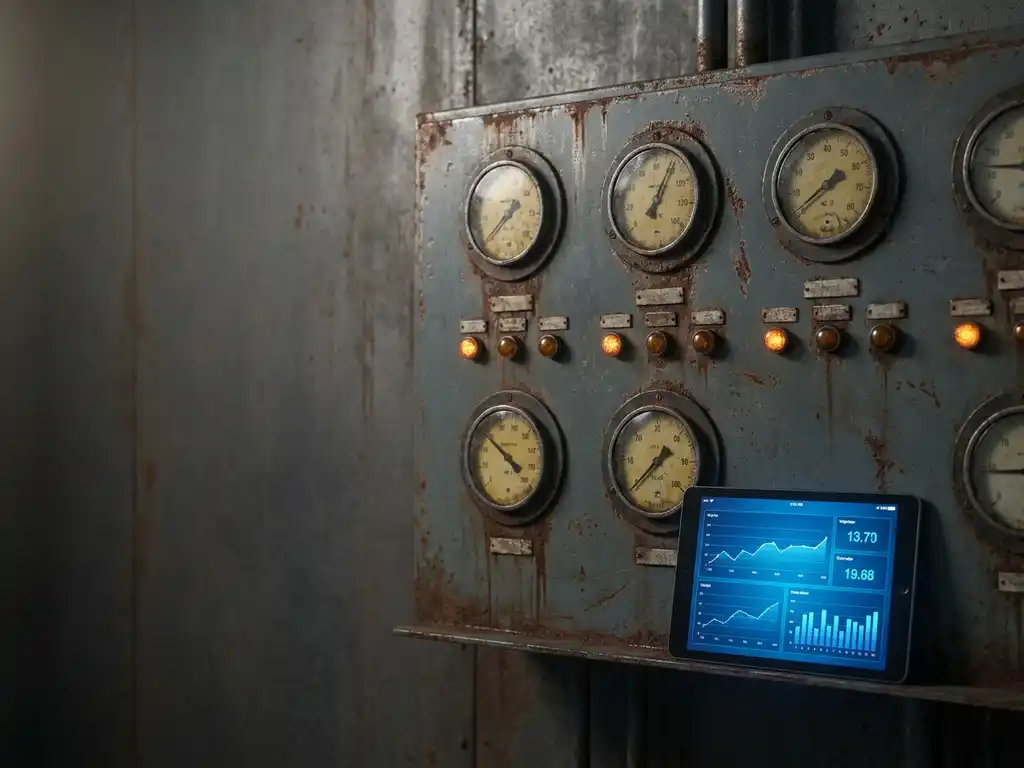


No, AI is not replacing IoT. Instead, AI and industrial IoT are converging into a more powerful combination than either technology delivers on its own. IoT provides the real-time data streams that AI needs to learn, predict, and act, while AI transforms raw sensor data into decisions that would be impossible to make manually. Together, they are reshaping how industrial operations are monitored, controlled, and optimized.
How does AI actually use IoT data?
AI uses IoT data as its primary input for learning patterns, detecting anomalies, and generating predictions. Industrial IoT sensors continuously collect measurements such as temperature, pressure, flow rates, and vibration. AI models process these streams to identify conditions that human operators might miss, triggering alerts or automated responses before problems escalate.
In practice, this means a machine learning model trained on months of sensor readings can flag when a pump is beginning to show early signs of failure, days before any visible symptom appears. The IoT network supplies the data; the AI supplies the interpretation. Without the IoT layer feeding it continuous, structured data, the AI model has nothing meaningful to work with.
What is the difference between IoT and AI?
IoT and AI are fundamentally different technologies that serve different purposes. IoT is a connectivity and data collection framework: it links physical devices, sensors, and machines to networks so that operational data can be gathered and transmitted. AI is an analytical and decision-making capability: it processes data to recognize patterns, make predictions, and automate responses.
A useful way to think about the distinction:
- IoT answers the question “What is happening right now?” by collecting and transmitting real-time measurements from the physical world.
- AI answers the question “What does it mean, and what should happen next?” by analyzing those measurements and generating insights or actions.
In industrial environments, both are necessary. IoT without AI produces large volumes of data that are difficult to act on at scale. AI without IoT lacks the real-time, high-frequency data that makes industrial predictions accurate and timely.
Why do people think AI is replacing IoT?
The perception that AI is replacing IoT stems from the fact that AI is currently receiving far more attention in the media and investment landscape. When AI capabilities become the headline feature of a new industrial platform, the underlying IoT infrastructure that makes it work tends to go unmentioned. This creates the impression that AI is the whole story.
There is also a genuine shift happening in how IoT projects are framed. Projects that were once described purely as “IoT implementations” are now more commonly presented as “AI-powered operations” or “intelligent automation.” The IoT infrastructure is still there and still essential, but the value proposition has shifted toward what AI does with the data rather than the act of collecting it. The result is a branding change more than a technological replacement.
What happens to IoT when AI is added to the edge?
When AI is deployed at the edge, meaning on or near the IoT devices themselves rather than in a central cloud, the industrial IoT network becomes significantly more capable and responsive. Edge AI allows decisions to be made locally, in milliseconds, without the latency of sending data to a remote server for processing. This is critical in industrial settings where a delayed response to an anomaly can cause equipment damage or safety incidents.
Adding AI to the edge does not reduce the role of IoT sensors and connectivity. It extends it. Sensors still collect the data, but instead of simply forwarding it upstream, edge devices can now filter, analyze, and act on it locally. This reduces bandwidth requirements, improves reliability in environments with limited connectivity, and enables real-time control loops that cloud-based AI cannot match for speed.
Should industrial companies invest in IoT, AI, or both?
Industrial companies should invest in both, but the sequencing matters. IoT infrastructure should come first, because without reliable, high-quality data from connected sensors and systems, AI models will produce unreliable outputs. A well-designed industrial IoT foundation is what makes AI investments pay off.
The practical approach for most industrial operations is:
- Establish connectivity: Ensure key equipment and process points are instrumented and connected, with data flowing consistently to a central or cloud-based platform.
- Build data quality: Clean, structured, and contextualized data is the prerequisite for effective machine learning. Invest in data governance alongside connectivity.
- Apply AI incrementally: Start with specific, high-value use cases such as predictive maintenance or energy optimization rather than attempting a broad AI rollout from the start.
- Scale what works: Once AI models prove their value in targeted applications, expand the approach to other areas of the operation.
Companies that skip the IoT foundation and jump straight to AI often find that poor data quality undermines their results. The two technologies are most effective when built together as a coherent strategy.
What does the future of IoT look like in an AI-driven world?
In an AI-driven world, industrial IoT evolves from a data collection infrastructure into an intelligent sensing layer that actively participates in decision-making. The future is not IoT being replaced, but IoT becoming smarter, more autonomous, and more deeply integrated with the control systems that run industrial processes.
Key directions shaping this future include:
- Autonomous process control: AI models trained on IoT data will increasingly adjust process parameters in real time without human intervention, optimizing yield, energy use, and equipment life simultaneously.
- Digital twins: Real-time IoT data feeds living digital replicas of physical assets and processes, allowing AI to simulate scenarios and test changes before they are applied in the real world.
- Predictive and prescriptive maintenance: Beyond predicting failures, AI will recommend the optimal maintenance action and timing, integrating with planning and procurement systems automatically.
- Unified operational and enterprise data: Industrial IoT data will increasingly connect with enterprise systems such as ERP and supply chain platforms, giving AI broader context to optimize decisions across the full value chain.
For industrial companies operating in chemical processing, oil and gas, food and beverage, or energy, this convergence represents a fundamental shift in what is operationally possible. The companies that invest in a solid IoT foundation now will be best positioned to capture the value that AI delivers as capabilities continue to mature through 2026 and beyond.
How CoNet helps with industrial IoT and AI
We help industrial companies build the connected foundation that makes AI-driven operations possible. Our industrial IoT and AI services team specializes in linking automation systems with cloud services and enterprise applications, turning raw process data into actionable insights. We work with platforms including Azure and MindSphere to design and implement IoT solutions that are secure, scalable, and ready for machine learning applications.
Specifically, we support industrial operations with:
- Designing and deploying Azure and MindSphere IoT architectures tailored to process environments
- Connecting existing Siemens PCS 7 and other automation systems to cloud and enterprise platforms
- Applying machine learning to process data to improve efficiency, reduce downtime, and optimize energy use
- Building mobile, web, and desktop applications that make process insights accessible to the right people at the right time
- Providing ongoing data analysis and consultancy to help teams act on what their data is telling them
Whether you are taking your first steps toward industrial IoT connectivity or looking to add AI capabilities to an existing data infrastructure, we are ready to help. Get in touch with our Process IT team to discuss what is possible for your operation.
Frequently Asked Questions
How do we know if our IoT data is good enough to start applying AI?
Your IoT data is ready for AI when it is consistent, timestamped, and covers enough historical range to reveal meaningful patterns — typically at least several months of clean sensor readings for use cases like predictive maintenance. A practical first check is to look for gaps in data streams, inconsistent units or labeling, and sensors that frequently go offline. If those issues are common, invest in data quality and governance first. A data audit conducted alongside your IoT platform provider can help you identify exactly where the gaps are before committing to an AI project.
What are the most common mistakes industrial companies make when combining IoT and AI?
The most frequent mistake is deploying AI before the IoT foundation is stable — models trained on incomplete or inconsistent sensor data will produce unreliable predictions that erode trust in the whole initiative. A close second is trying to solve too many problems at once; broad AI rollouts across an entire facility tend to stall, while focused pilots on a single high-value use case like pump failure or energy waste are far more likely to succeed and build internal momentum. Finally, many companies underestimate the importance of contextualizing data — raw sensor readings without equipment metadata, operating modes, or process context significantly limit what AI models can learn.
Can AI and IoT be added to older industrial equipment, or does it require replacing legacy systems?
In most cases, legacy equipment does not need to be replaced. Retrofitting is a well-established approach: external sensors can be attached to older machines to capture vibration, temperature, or current draw, and edge gateways can bridge older communication protocols like Modbus or PROFIBUS to modern cloud platforms. This means a 20-year-old compressor or heat exchanger can participate in a predictive maintenance program without a capital replacement. The key is working with an integration specialist who understands both the legacy automation layer and the modern IoT and cloud stack.
How long does it typically take to see ROI from an industrial IoT and AI project?
For well-scoped pilot projects focused on a specific outcome — such as reducing unplanned downtime on a critical asset or cutting energy consumption in a defined process area — ROI is often visible within 6 to 12 months. The timeline depends heavily on how quickly clean, reliable data can be collected and whether the AI model is being trained from scratch or adapted from a pre-trained baseline. Companies that start with a clear business case, a defined KPI, and an existing IoT data stream tend to reach positive ROI the fastest. Broad, undefined AI initiatives with no specific target metric rarely deliver measurable returns within the first year.
What is the difference between predictive maintenance and prescriptive maintenance, and which should we aim for?
Predictive maintenance tells you that a failure is likely to occur — for example, flagging that a bearing is showing early degradation signatures and will probably fail within the next two weeks. Prescriptive maintenance goes a step further and recommends the specific action to take, such as which replacement part to order, the optimal maintenance window that minimizes production impact, and how urgently the work needs to be scheduled. Most industrial operations should start with predictive maintenance, as it requires less model maturity and delivers immediate value by reducing unexpected breakdowns. Prescriptive capabilities become achievable once you have reliable predictions and have integrated your IoT and AI platform with maintenance planning and procurement systems.
Is edge AI secure, and how do we protect sensitive process data when AI is running on-site?
Edge AI can be made highly secure, and in many cases it actually improves security compared to cloud-only architectures because sensitive process data can be analyzed locally without ever leaving the facility network. Best practices include encrypting data both at rest and in transit, applying strict access controls to edge devices, keeping firmware and AI model deployments on a managed update cycle, and segmenting the IoT network from corporate IT systems. Working with platforms like Azure IoT Edge provides a managed security framework that includes device authentication, over-the-air updates, and monitoring for anomalous device behavior.
How do we get internal buy-in for an IoT and AI investment when the benefits are hard to quantify upfront?
The most effective approach is to anchor the business case to a specific, measurable pain point that leadership already recognizes — such as the annual cost of a recurring unplanned shutdown, the energy bill for a specific process unit, or the labor hours spent manually reviewing alarm data. Running a time-limited pilot on that single problem, with agreed KPIs measured before and after, creates concrete evidence that is far more persuasive than projected ROI from a broad initiative. Framing the IoT and AI investment as an extension of existing operational improvement programs, rather than a standalone technology project, also tends to reduce resistance and align it with budgets that are already approved.