
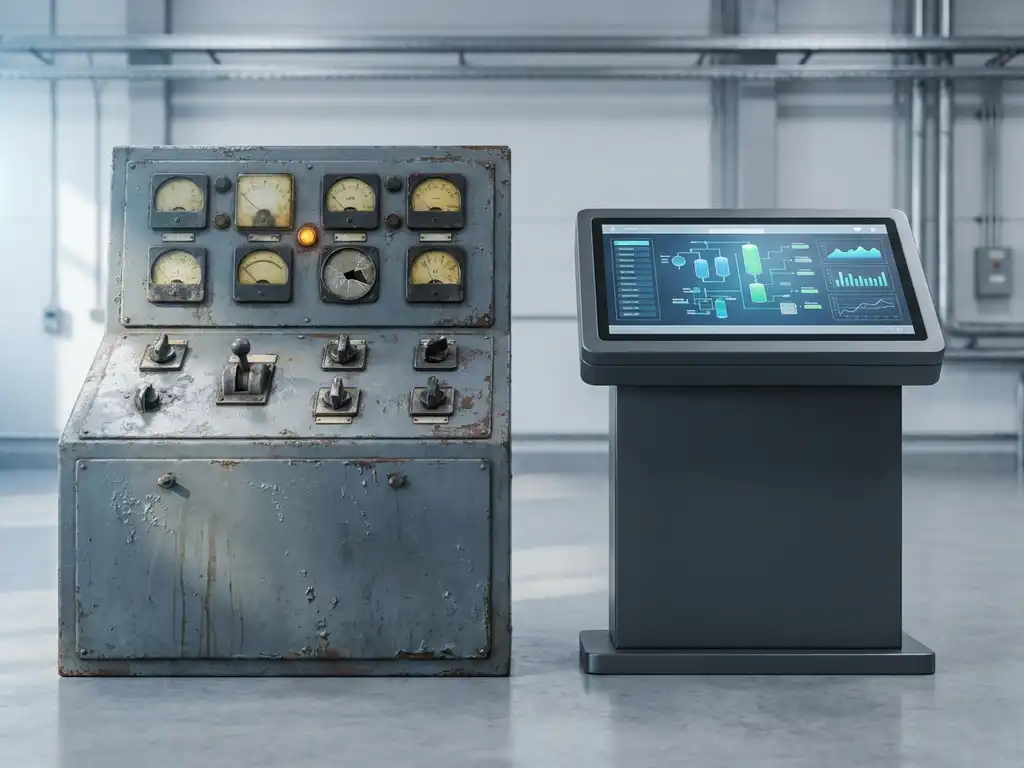
Migrating to a modern DCS delivers faster processing, better integration, stronger cybersecurity, and significantly improved visibility into your processes. For most industrial operations running on ageing control systems, the benefits go well beyond convenience: they directly affect uptime, safety, and the ability to compete. Below, we answer the most common questions about DCS migration so you can make an informed decision.
What are the biggest risks of staying on a legacy DCS?
The biggest risks of staying on a legacy DCS are unplanned downtime, rising maintenance costs, and shrinking vendor support. Older distributed control systems rely on hardware and software that manufacturers no longer actively develop, meaning spare parts become scarce, patches stop arriving, and finding engineers who understand the platform grows harder every year.
Beyond availability, legacy systems create operational blind spots. They typically lack modern diagnostic tools, making it difficult to detect early signs of equipment degradation before a failure occurs. When something does go wrong, troubleshooting takes longer because documentation is outdated and institutional knowledge walks out the door as experienced engineers retire.
There is also a regulatory dimension. Industries such as chemical processing, oil and gas, and food and beverage face evolving compliance requirements. An ageing DCS may struggle to generate the audit trails, alarm management records, or safety function documentation that regulators increasingly expect.
How does a modern DCS improve process performance?
A modern DCS improves process performance by enabling faster control loops, richer data collection, and tighter integration between field devices, control logic, and higher-level systems like MES and ERP platforms. The result is more consistent product quality, fewer process deviations, and better use of raw materials and energy.
Contemporary platforms such as Siemens SIMATIC PCS 7 and its successors are built around high-resolution diagnostics and advanced process control capabilities. Engineers can configure alarm hierarchies more precisely, reducing alarm floods that distract operators during critical moments. Batch processes benefit from more granular recipe management, while continuous processes gain from tighter feedback loops and predictive control strategies.
Integration is another major performance lever. Modern DCS platforms communicate natively with asset management tools, condition monitoring systems, and cloud-based analytics and integration services. This connectivity turns raw process data into actionable insight, allowing teams to spot inefficiencies, optimise setpoints, and schedule maintenance proactively rather than reactively.
What cybersecurity advantages does a modern DCS offer?
A modern DCS offers built-in cybersecurity features that legacy systems were never designed to provide, including role-based access control, encrypted communications, network segmentation support, and regular vendor security patches. These capabilities are essential as industrial control systems face a growing volume of targeted cyberattacks.
Legacy DCS platforms were engineered in an era when operational technology networks were largely isolated from the outside world. That isolation no longer holds. Remote access requirements, cloud connectivity, and IT/OT convergence have opened pathways that older systems cannot adequately protect. A modern DCS is designed with these realities in mind, aligning with frameworks such as IEC 62443 for industrial cybersecurity.
Vendor support is equally important. Modern platforms receive ongoing security updates, whereas legacy systems may go years without a patch simply because the vendor has deprioritised or discontinued the product line. Running unsupported software on a process-critical system is an exposure that grows more serious with every passing month.
How much does DCS migration typically cost?
DCS migration costs vary widely depending on system size, the complexity of existing configurations, the migration strategy chosen, and the level of process disruption that can be tolerated. Smaller installations may be completed for a fraction of the budget required for large, multi-unit plants, but every project involves engineering, hardware, testing, and commissioning costs that must be planned carefully.
The migration strategy itself has a significant impact on total cost:
- Phased migration spreads investment over time, allowing sections of the plant to be upgraded while others remain operational. This reduces production risk but extends the project timeline.
- Like-for-like replacement swaps old hardware for new within the same control architecture, minimising re-engineering effort but potentially leaving performance gains on the table.
- Full system redesign takes a clean-sheet approach, optimising control strategies and integrations from scratch. It delivers the greatest long-term benefit but requires the most upfront investment.
It is worth factoring in the cost of not migrating. Unplanned outages, emergency spare parts procurement, and the productivity gap between an optimised modern system and an ageing one all carry real financial consequences that are easy to underestimate when comparing migration quotes.
When is the right time to migrate your DCS?
The right time to migrate your DCS is before a failure forces your hand. Reactive migration driven by an emergency is always more expensive and disruptive than a planned project. Proactive indicators that the time has come include end-of-support announcements from your vendor, increasing difficulty sourcing spare parts, a growing backlog of deferred maintenance, and staff struggling to find training on the platform.
Planned plant shutdowns, turnarounds, or capital investment cycles are natural windows for migration work. Aligning a DCS upgrade with a scheduled outage avoids the need to take the process offline specifically for the project, which can dramatically reduce the cost and operational impact.
Regulatory drivers also create natural timelines. If your current system cannot support updated safety integrity level requirements, new alarm management standards, or evolving data retention obligations, those deadlines effectively set your migration window for you.
What should you look for in a DCS migration partner?
The right DCS migration partner combines deep platform expertise with genuine process knowledge in your industry. Technical certification alone is not enough: your partner needs to understand both the control system and the process it governs, so that migration decisions are made with operational outcomes in mind, not just engineering convenience.
Key qualities to evaluate include:
- Platform specialisation: Partners who focus on a specific DCS platform develop deeper knowledge than generalists who work across many systems.
- Industry experience: A partner with a track record in your sector understands the regulatory environment, typical process challenges, and the standards that apply to your operations.
- Safety credentials: For safety-instrumented systems and process safety functions, verify that the partner holds relevant certifications such as Siemens PCS 7 Process Safety Specialist status.
- Migration methodology: Ask how they approach risk management, testing, and cutover. A structured, documented methodology reduces the chance of surprises during commissioning.
- Post-migration support: The relationship should not end at handover. Ongoing support, training, and access to expertise during the stabilisation period are indicators of a partner invested in your long-term success.
How CoNet helps with DCS migration
We have been supporting industrial organisations through complex DCS projects since 1996, with a singular focus on Siemens technologies. That focus means our team develops genuine depth rather than spreading expertise thinly across competing platforms. Whether you are assessing whether migration makes sense, planning a phased upgrade, or executing a full system replacement, we bring the engineering hours, the certifications, and the industry knowledge to do it properly.
Here is what working with us looks like in practice:
- We conduct a thorough assessment of your current system, identifying risks, gaps, and opportunities before any engineering work begins.
- We develop a migration strategy tailored to your production schedule, risk tolerance, and budget, including phased approaches that keep operations running.
- As the only organisation in the Netherlands certified as both a Siemens PCS 7 Process Safety Specialist and a Siemens COMOS Partner, we handle safety-critical migrations with the credentials to back it up.
- We deliver engineering, commissioning, and post-migration support from a team of 62 specialists, with offices in Zaandam and Warrington to serve clients across Europe.
- We deliver between 40,000 and 50,000 engineering hours annually, meaning we have the capacity to support projects of meaningful scale without compromising quality.
If you are weighing up whether now is the right time to migrate, or you already know it is and want to understand what the process looks like, get in touch with our migration team. We are happy to have a straightforward conversation about your situation and what a migration project would realistically involve.
Frequently Asked Questions
How long does a typical DCS migration project take from start to finish?
Project duration depends heavily on plant size, migration strategy, and how much downtime can be scheduled. A phased migration for a mid-sized facility might run 12–24 months, while a full system redesign for a large, multi-unit plant can extend to several years. Aligning migration phases with planned shutdowns or turnarounds is one of the most effective ways to compress the overall timeline without increasing operational risk.
Can we migrate our DCS without shutting down production?
In many cases, yes — a phased migration strategy is specifically designed to keep operations running by upgrading one section of the plant at a time while the rest continues under the legacy system. This approach requires careful boundary management between old and new systems, robust testing at each phase boundary, and clear cutover procedures. Your migration partner’s methodology for managing these live cutovers is one of the most important things to scrutinise before committing to a project.
What happens to our existing control logic, recipes, and configurations during migration?
Existing control logic, recipes, and alarm configurations are typically reviewed, documented, and translated into the new platform rather than simply copied across. This review stage is actually an opportunity: many plants discover that legacy configurations contain obsolete logic, poorly tuned loops, or undocumented workarounds that can be cleaned up during migration. A good migration partner will flag these issues and work with your engineering team to decide what to carry forward and what to optimise.
How do we handle staff training when moving to a new DCS platform?
Operator and engineering training should be treated as a formal workstream within the migration project, not an afterthought. Most modern DCS vendors, including Siemens, offer structured training programmes for both operators and engineers, and your migration partner should be able to supplement these with site-specific training on your configured system. Running parallel operations during phased cutovers also gives operators valuable hands-on exposure to the new platform before they are fully dependent on it.
What are the most common mistakes companies make during DCS migration?
The most frequent mistakes are underestimating the engineering effort required to document and translate legacy configurations, skipping or compressing the factory acceptance testing (FAT) phase to save time, and treating training as an afterthought rather than a planned deliverable. Another common pitfall is selecting a migration partner based primarily on price rather than platform depth and industry experience — gaps in expertise tend to surface during commissioning, which is the worst possible moment to discover them.
How do we make the business case for DCS migration to senior leadership?
The strongest business cases combine hard cost avoidance figures — such as the estimated cost of a single unplanned outage, emergency spare parts premiums, and rising maintenance labour — with performance uplift projections based on reduced process variability and better energy efficiency. It also helps to quantify the risk exposure of staying on an unsupported platform, including potential regulatory penalties and cybersecurity liability. Framing migration as risk mitigation with a productivity upside, rather than purely a capital expenditure, tends to resonate more effectively with finance and executive stakeholders.
Does migrating to a modern DCS affect our functional safety certifications and SIL ratings?
Yes, any changes to a safety-instrumented system or safety-related control functions must be carefully managed to preserve existing Safety Integrity Level (SIL) ratings and functional safety certifications. This typically involves a formal management of change (MOC) process, re-validation of safety functions on the new platform, and updated safety lifecycle documentation. It is essential to work with a migration partner who holds recognised safety credentials — such as Siemens PCS 7 Process Safety Specialist certification — and has direct experience managing safety function migrations within your industry’s regulatory framework.