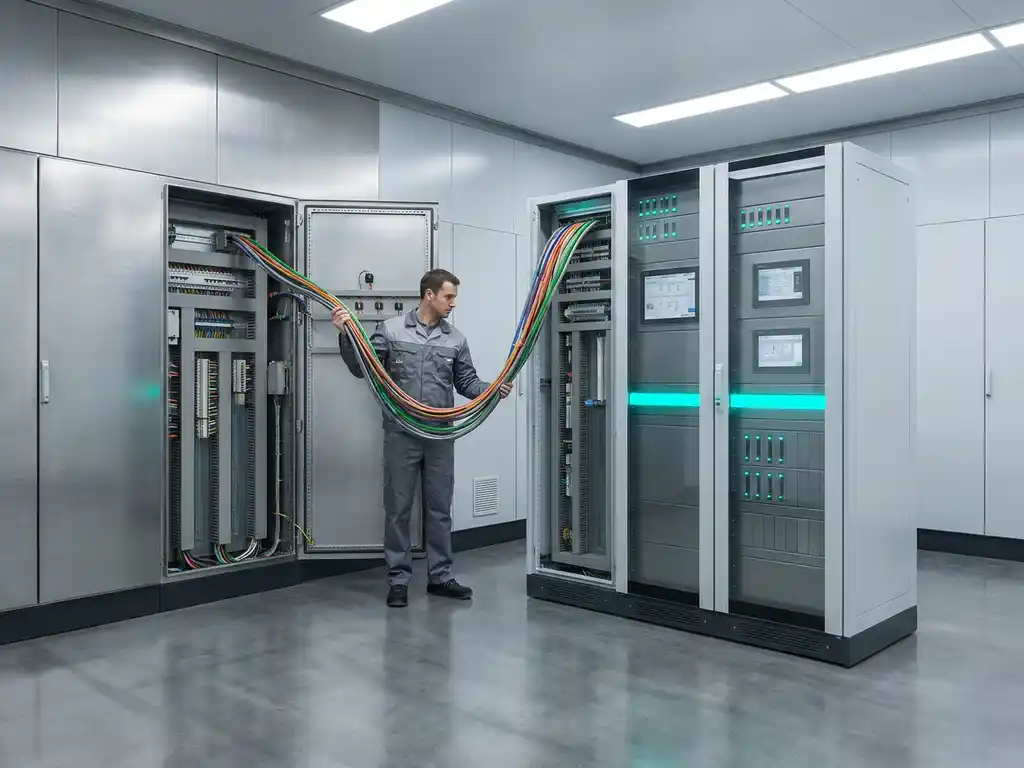
Cybersecurity applies to DCS environments by protecting the control systems, networks, and data that manage critical industrial processes from unauthorized access, manipulation, and disruption. Because a distributed control system (DCS) directly governs physical operations, a successful cyberattack can cause equipment damage, production loss, safety incidents, or environmental harm. The sections below unpack the most important questions around DCS cybersecurity, from the threats you face to the standards and practical measures that keep your systems secure.
What are the biggest cybersecurity threats to DCS environments?
The biggest cybersecurity threats to DCS environments include ransomware attacks, unauthorized remote access, insider threats, and supply chain compromises. Unlike typical IT breaches that target data, attacks on a DCS can halt production lines, damage physical equipment, or create dangerous process conditions that put people and the environment at risk.
Ransomware has become one of the most disruptive threats to industrial environments. Attackers encrypt engineering workstations or historian servers, effectively blinding operators and forcing costly shutdowns. Remote access vulnerabilities are equally dangerous: maintenance connections that were set up for convenience often lack strong authentication, giving attackers a direct path into the control network. Insider threats, whether from malicious employees or simple human error, are compounded by the fact that DCS operators often have broad system privileges. Finally, supply chain attacks, where malicious code is introduced through a software update or by a compromised vendor, are increasingly common and particularly hard to detect.
How is OT cybersecurity different from IT cybersecurity?
OT (Operational Technology) cybersecurity prioritizes availability and safety above all else, whereas IT cybersecurity typically prioritizes confidentiality and data integrity. In a DCS environment, a system that goes offline to apply a security patch can be more disruptive than the threat the patch addresses, which fundamentally changes how security decisions are made.
In IT environments, patching quickly is standard practice. In OT, the same patch might need months of vendor validation and a planned maintenance window before it can be safely applied. IT systems are also replaced on relatively short cycles, while DCS components are often designed to run for 20 to 30 years. This means security controls must be designed around legacy hardware and software that can no longer receive vendor support. Additionally, many OT protocols, such as PROFIBUS or Modbus, were designed for reliability rather than security, and they lack built-in authentication or encryption.
The consequences of failure also differ dramatically. A compromised IT server may result in a data breach. A compromised DCS may result in a reactor running outside safe parameters, a pipeline rupturing, or a food production line being contaminated. This is why OT cybersecurity requires its own discipline, frameworks, and expertise.
What does IEC 62443 require for DCS security?
IEC 62443 is the international standard for industrial cybersecurity. For DCS environments, it requires organizations to define security levels for each zone and conduit in the control network, implement security management systems, and ensure that both the system and its components meet defined security capability requirements throughout their lifecycle.
The standard organizes requirements across four parts, covering policies and procedures, risk management, system design, and component-level security. Practically speaking, this means a DCS operator must:
- Conduct a formal risk assessment to identify vulnerabilities and threats
- Divide the control network into zones based on criticality and assign conduits to manage communication between them
- Define a target Security Level (SL) for each zone, from SL 1 (basic protection) to SL 4 (protection against state-level threats)
- Implement technical and organizational controls to meet those security levels
- Maintain documentation and continuously monitor and review the security posture
IEC 62443 is not a one-time checklist. It requires ongoing governance, which means security responsibilities must be clearly assigned within the organization and revisited regularly as the system evolves.
How does network segmentation protect a DCS?
Network segmentation protects a DCS by dividing the control network into isolated zones so that a breach in one area cannot spread freely to the rest of the system. By controlling all traffic between zones through firewalls, data diodes, or demilitarized zones (DMZs), segmentation limits the blast radius of any attack.
A well-segmented DCS architecture typically separates the enterprise network, the operations network, and the control network into distinct layers. Communication between these layers is tightly controlled and logged. For example, a historian server that needs to pass process data to the business network sits in a DMZ rather than having a direct connection between the control layer and the corporate IT environment. This prevents an attacker who compromises a business laptop from reaching the DCS controllers directly.
Segmentation also makes monitoring more effective. When network traffic is organized into defined zones, anomalies are easier to spot. Unexpected communication between a controller and an external address becomes immediately visible rather than buried in undifferentiated network noise.
How do you patch and update a DCS without causing downtime?
Patching a DCS without causing downtime requires a structured approach that includes vendor validation, staging environments, redundancy, and carefully planned maintenance windows. The goal is to apply necessary security updates while maintaining process continuity and system integrity.
The process typically follows these steps:
- Vendor validation: Confirm with the DCS vendor that the patch is compatible with your specific system version and configuration. Applying an unvalidated patch can introduce instability.
- Test environment: Apply the patch to a non-production replica of the system first. This surfaces conflicts or unexpected behavior before they can affect live operations.
- Redundancy planning: Where the DCS architecture includes redundant controllers or servers, patches can sometimes be applied to the standby unit first, with a controlled failover, then applied to the primary.
- Scheduled maintenance window: For patches that require a full restart, coordinate with operations to identify the lowest-impact window and prepare a rollback plan in case issues arise.
- Post-patch verification: After applying the update, run functional checks to confirm all process values, alarms, and control loops are behaving as expected before returning to normal operations.
Compensating controls, such as additional network monitoring or temporary access restrictions, can reduce risk during periods when patching is delayed due to operational constraints.
When should a DCS cybersecurity risk assessment be carried out?
A DCS cybersecurity risk assessment should be carried out at initial system commissioning, after any significant system change, following a security incident, and on a regular periodic basis, typically every one to three years depending on the criticality of the process. Waiting until a threat materializes is too late.
Specific triggers that should prompt an unscheduled assessment include:
- Adding new remote access capabilities or third-party connections
- Integrating the DCS with enterprise IT systems or cloud platforms
- Upgrading or replacing major DCS components
- A known vulnerability being published that affects your system version
- A security incident affecting a similar system in your industry
The assessment should examine the threat landscape, identify vulnerabilities in the current architecture, evaluate existing controls, and produce a prioritized remediation plan. It should involve both OT specialists and, where relevant, process safety engineers, because cybersecurity risks in a DCS can directly interact with functional safety systems.
How CoNet helps with DCS cybersecurity
We work with industrial organizations to assess, design, and strengthen the cybersecurity posture of their DCS environments, with deep expertise in Siemens PCS 7 and related automation platforms. Our DCS cybersecurity and OT security services are practical and grounded in real operational constraints, meaning we help you achieve meaningful security improvements without compromising process availability.
Here is what we offer:
- Cybersecurity risk assessments aligned with IEC 62443, covering your full control system architecture
- Network segmentation design that fits your existing DCS topology and operational requirements
- Patch management planning that accounts for vendor validation, redundancy, and production schedules
- Ongoing monitoring and support to detect anomalies and respond to emerging threats
- Security consultancy for system upgrades, remote access implementations, and IT/OT integration projects
If you want to understand where your DCS stands from a cybersecurity perspective, get in touch to discuss your situation. We are happy to discuss your situation and help you take the right next step.
Frequently Asked Questions
What is the difference between a DCS and a SCADA system, and do the same cybersecurity principles apply to both?
A DCS is typically used for continuous process control within a single facility, such as a chemical plant or refinery, while SCADA systems are designed to monitor and control assets spread across large geographic areas, such as pipelines or power grids. The core cybersecurity principles, including network segmentation, access control, and risk assessment, apply to both, but the implementation differs. SCADA systems often rely more heavily on remote communication links, which introduces additional exposure points that require specific controls such as encrypted telemetry and secure remote terminal unit (RTU) configurations.
How do we manage third-party vendor access to our DCS without creating security vulnerabilities?
Third-party vendor access should always be governed by a formal remote access policy that enforces multi-factor authentication, time-limited sessions, and least-privilege permissions, meaning vendors only access the specific assets they need for a defined period. All sessions should be logged and, where possible, monitored in real time through a jump server or privileged access management (PAM) solution. Avoid leaving persistent VPN credentials or shared accounts active between maintenance visits, as these are among the most commonly exploited entry points in OT environments.
What compensating controls can we put in place if we cannot patch our DCS components right away?
When patching is delayed due to operational or vendor constraints, compensating controls help reduce the exposure window. The most effective measures include tightening network segmentation to isolate vulnerable components, deploying application whitelisting on engineering workstations, disabling unused ports and services, and increasing monitoring sensitivity around the affected assets. Documenting these compensating controls formally is also important, both for internal governance and for demonstrating due diligence under frameworks such as IEC 62443.
How do we build a cybersecurity incident response plan specifically for a DCS environment?
A DCS-specific incident response plan must account for the fact that your primary obligation during an incident is maintaining process safety, not just containing the cyber threat. The plan should define clear roles for both OT engineers and cybersecurity personnel, establish communication protocols between the control room and IT or security teams, and include pre-approved playbooks for scenarios such as ransomware on a historian server or unauthorized access to a controller. Critically, the plan should be tested through tabletop exercises that involve operations staff, not just IT or security teams, to ensure it is realistic and actionable under pressure.
What are the most common mistakes organizations make when starting a DCS cybersecurity program?
The most common mistake is applying IT security practices directly to OT without adapting them to the operational context, such as pushing aggressive patch cycles or deploying security tools that generate enough network traffic to interfere with time-sensitive control communications. Another frequent error is treating cybersecurity as a one-time project rather than an ongoing program, which means risk assessments go stale and new vulnerabilities introduced by system changes go unaddressed. Starting with a thorough asset inventory and risk assessment tailored to your specific DCS environment gives you a solid, prioritized foundation rather than a generic checklist.
How does DCS cybersecurity interact with functional safety systems such as a Safety Instrumented System (SIS)?
A DCS and a Safety Instrumented System (SIS) are often physically or logically connected, which means a cyberattack targeting the DCS can potentially affect the SIS’s ability to respond to a hazardous process condition. IEC 62443 and IEC 61511 both address this overlap and recommend that SIS networks be isolated from the DCS control network wherever possible. Any cybersecurity risk assessment for a DCS should involve process safety engineers to ensure that the security controls implemented do not inadvertently compromise the integrity or availability of safety functions.
How long does it typically take to achieve IEC 62443 compliance for an existing DCS installation?
For an existing DCS installation, achieving meaningful IEC 62443 alignment typically takes anywhere from six months to two or more years, depending on the complexity of the system, the maturity of existing security controls, and the resources available. The process usually begins with a gap assessment to establish a baseline, followed by prioritized remediation work organized into phases that minimize operational disruption. Rather than viewing compliance as a fixed finish line, most organizations find it more practical to treat IEC 62443 as a continuous improvement framework, addressing the highest-risk gaps first and progressively raising the security level across their control system zones.