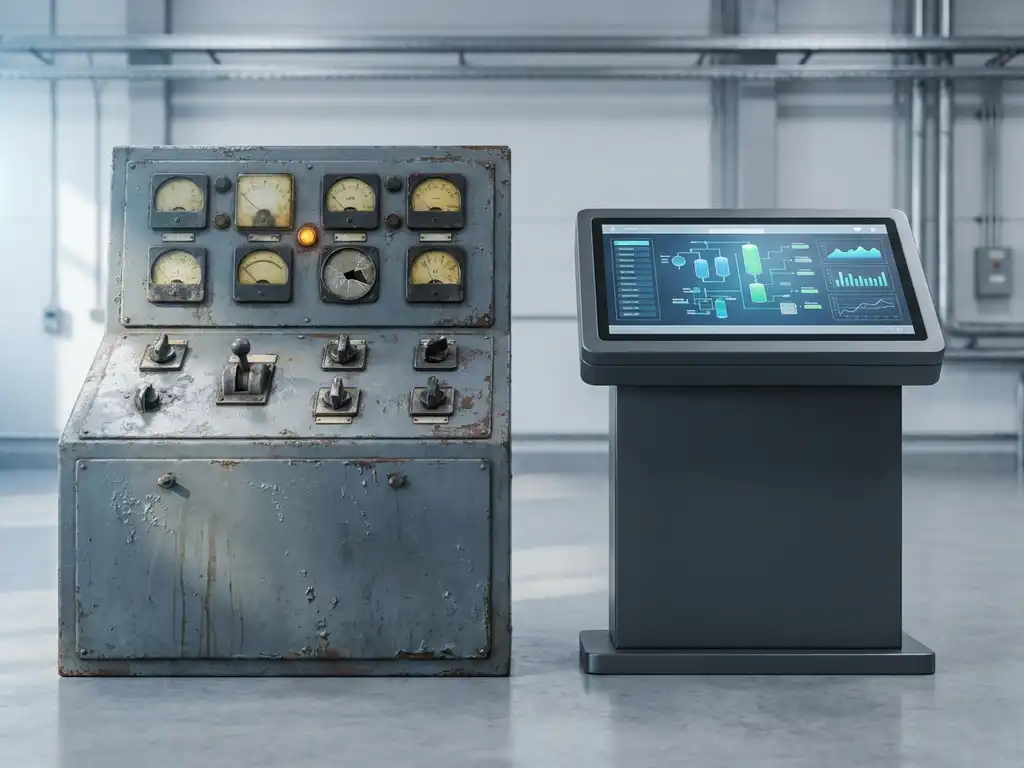


Batch management is a method of controlling manufacturing processes where materials are produced in discrete, defined quantities called batches, rather than in a continuous flow. Each batch follows a specific sequence of steps, conditions, and ingredient quantities to produce a consistent, repeatable output. The sections below unpack how batch control works, why it follows international standards, and which systems support it best.
How does batch management work in industrial automation?
Batch management works by breaking a production process into a structured sequence of phases and operations, each governed by a set of instructions called a recipe. An automation system executes these instructions step by step, controlling equipment such as reactors, mixers, and dosing units to ensure every batch meets the same quality and quantity targets.
At its core, batch control relies on three interconnected elements: the recipe (what to do), the equipment (what to do it with), and the process data (what actually happened). The batch management system coordinates all three in real time, monitoring conditions like temperature, pressure, and flow rate, and adjusting control outputs to keep the process on track.
When a batch is complete, the system generates an electronic batch record that documents every step, every measured value, and every deviation. This record is essential for quality assurance, regulatory compliance, and process improvement. Without a dedicated batch management layer, operators would need to execute and record these steps manually, which introduces inconsistency and human error.
What is the ISA-88 standard and why does batch control follow it?
ISA-88 is an international standard that defines a common framework for batch process control, including a physical model for equipment, a procedural model for recipes, and a set of terminology that all stakeholders can share. Batch control follows ISA-88 because it provides a structured, vendor-neutral language for describing how batch processes are organized and executed.
Before ISA-88, different suppliers, engineers, and plant operators used incompatible terminology and system architectures, making integration and knowledge transfer difficult. The standard introduced a hierarchy that most engineers now recognize:
- Procedure: The overall recipe for making a product
- Unit procedure: A major phase carried out in a single piece of equipment
- Operation: A significant step within a unit procedure
- Phase: The lowest-level action that directly controls equipment
By aligning batch management systems with ISA-88, manufacturers gain flexibility. Recipes can be written independently of the specific equipment that will run them, which makes it far easier to transfer production between lines, scale up to new facilities, or integrate systems from different vendors. It also simplifies regulatory audits, because the structured documentation maps directly to the process steps reviewers need to verify.
What types of industries use batch management systems?
Batch management systems are used in any industry where products are made in defined quantities rather than as a continuous stream. The most common sectors are pharmaceuticals, food and beverage, specialty chemicals, and agrochemicals, where recipe-driven production and traceability are critical requirements.
In pharmaceuticals, every ingredient, every mixing time, and every temperature reading must be recorded and traceable to meet regulatory requirements. In food and beverage, batch control ensures that flavour profiles, nutritional values, and allergen declarations remain consistent from one production run to the next. In the chemical industry, batch processes are used for products that would be unsafe or impractical to manufacture continuously, such as adhesives, coatings, and fine chemicals.
Energy and water treatment facilities also use batch-style control for processes like chemical dosing, where defined quantities of treatment agents are added at scheduled intervals. The common thread across all these industries is the need for repeatability, documentation, and the ability to trace any finished product back to the raw materials and conditions used to make it.
What’s the difference between batch management and recipe management?
Recipe management is a subset of batch management. Recipe management focuses on defining, storing, and versioning the instructions for making a product, while batch management encompasses the full lifecycle of a production run, including scheduling, execution, equipment allocation, and batch record generation.
Think of recipe management as the planning layer and batch management as the operational layer. A recipe specifies what ingredients to use, in what quantities, and in what sequence. Batch management takes that recipe and coordinates the actual execution across real equipment, tracks the process in real time, handles exceptions, and produces the documentation that proves the batch was made correctly.
In practice, the two are tightly linked. A batch management system cannot function without well-structured recipes, and recipe management alone provides no mechanism for executing or monitoring a production run. Modern batch management platforms integrate both functions, allowing engineers to build and validate recipes in one environment and then deploy them directly to the production floor.
How does Siemens PCS 7 handle batch management?
Siemens PCS 7 handles batch management through a dedicated module called SIMATIC Batch, which integrates directly with the PCS 7 process control system. SIMATIC Batch follows the ISA-88 standard and provides tools for recipe creation, batch scheduling, real-time execution monitoring, and automated batch reporting.
Within PCS 7, the engineering environment allows process engineers to build master recipes using a graphical interface, linking procedural steps to the physical equipment objects already defined in the control system. When a batch is started, SIMATIC Batch communicates with the underlying PCS 7 controllers to execute each phase, passing parameters and receiving status signals in real time.
Key capabilities of SIMATIC Batch within PCS 7 include:
- Master recipe management with version control and approval workflows
- Equipment allocation and conflict detection across production lines
- Real-time batch monitoring with alarm and event logging
- Automatic electronic batch records compliant with regulatory requirements
- Integration with process historians and enterprise systems for full data continuity
Because SIMATIC Batch is built natively into the PCS 7 architecture, there is no need for a separate integration layer between the batch management system and the process controllers. This tight coupling reduces engineering effort, minimizes communication latency, and ensures that the batch record reflects exactly what the control system executed.
What are the key benefits of a dedicated batch management system?
A dedicated batch management system delivers consistency, traceability, and operational efficiency that manual or ad hoc approaches cannot match. By automating the execution and documentation of every production run, it reduces human error, shortens changeover times, and provides the data needed to continuously improve process performance.
The most significant benefits include:
- Reproducibility: Every batch follows the same validated sequence, eliminating variation caused by operator differences or manual timing
- Traceability: Automated batch records link every finished product to the raw materials, equipment states, and process conditions used during production
- Regulatory compliance: Structured electronic records simplify audits and reduce the time needed to respond to regulatory inquiries
- Faster product changeover: Recipe-driven systems allow operators to switch between products by selecting a different master recipe rather than reconfiguring equipment manually
- Continuous improvement: Batch data captured over time reveals patterns in yield, cycle time, and quality that engineers can use to optimize the process
Beyond these operational gains, a dedicated batch management system also reduces the risk of costly batch failures. When a deviation occurs, the system can pause execution, alert operators, and log the event with full context, making it far easier to investigate the root cause and decide whether the batch can be recovered or must be rejected.
How CoNet helps with batch management
We are a Siemens specialist with deep expertise in SIMATIC PCS 7 and SIMATIC Batch, and we support manufacturers across the full batch management lifecycle, from initial design through to ongoing optimization. Whether you are implementing batch control for the first time or looking to modernize an existing system, we bring the technical depth and hands-on experience to make it work reliably in your environment.
Here is what working with us looks like in practice:
- Batch system design and engineering: We design ISA-88-compliant batch architectures tailored to your process, equipment, and regulatory requirements
- SIMATIC Batch implementation: We configure, test, and commission SIMATIC Batch within your PCS 7 environment, including master recipe development and equipment phase library setup
- Integration with enterprise systems: Through our Process IT and automation integration services, we connect your batch data to cloud platforms, ERP systems, and analytics tools so your operational data drives real business decisions
- Validation and compliance support: We help you build the documentation and testing evidence needed to satisfy regulatory requirements in pharmaceutical and food production environments
- Training and ongoing support: We train your engineering and operations teams to manage and extend the system independently, and we remain available for support when you need us
If you are ready to improve consistency, traceability, and efficiency in your batch production, get in touch with our batch management specialists to discuss your situation and find out how we can help.
Frequently Asked Questions
How long does it typically take to implement a batch management system like SIMATIC Batch?
Implementation timelines vary depending on process complexity, the number of recipes, and the scope of equipment integration, but most projects range from a few months for straightforward installations to over a year for large, multi-line pharmaceutical facilities. Key phases include system design, engineering and configuration, factory acceptance testing, site commissioning, and validation. Engaging a specialist early in the project significantly reduces rework and helps keep the schedule on track.
What is the difference between a master recipe and a control recipe in ISA-88?
A master recipe is the validated, site-level template that defines how a product should be made — it contains the procedural steps, ingredient quantities, and process parameters but is not tied to specific equipment. A control recipe is a working copy of the master recipe that has been adapted for a specific batch, assigned to particular equipment, and is actively being executed or has already run. This separation is important because it allows you to maintain a single validated master recipe while running multiple batches simultaneously on different production lines.
Can a batch management system integrate with our existing ERP or MES platform?
Yes, modern batch management systems including SIMATIC Batch are designed to exchange data with ERP systems such as SAP and MES platforms through standard interfaces like OPC UA, REST APIs, or dedicated connectors. This integration enables automated order handover from ERP to the batch system, real-time production status updates, and the automatic transfer of completed batch records into your quality and inventory management workflows. The key is ensuring your integration architecture is defined during the design phase rather than treated as an afterthought.
What happens if a deviation or equipment failure occurs mid-batch?
A dedicated batch management system handles mid-batch deviations by pausing execution, triggering alarms, and logging the event with a full timestamp and process context — including the exact phase and parameter values at the moment of the deviation. Depending on how the system is configured, operators may be prompted to acknowledge the issue and choose a recovery path, such as repeating a phase, skipping a step with justification, or aborting the batch entirely. All decisions and their rationale are recorded in the electronic batch record, which is critical for regulatory review and root cause analysis.
Do we need to revalidate our recipes every time we make a minor process change?
Not necessarily, but any change to a master recipe must go through a formal change control process to assess whether revalidation is required. Minor parameter adjustments within a pre-approved operating range — sometimes called the design space in pharmaceutical contexts — may only require a documented review and approval rather than a full revalidation campaign. A well-structured batch management system with built-in version control and approval workflows makes this process significantly more efficient by maintaining a clear audit trail of what changed, who approved it, and when.
What is the biggest mistake companies make when implementing batch management for the first time?
The most common mistake is trying to digitize existing manual processes without first rationalizing and standardizing them. If your current batch procedures are inconsistent or poorly documented, automating them will simply make those inconsistencies faster and harder to spot. Before configuring any software, it is worth investing time in aligning your recipes to ISA-88 structures, cleaning up your equipment models, and agreeing on standard phase libraries — this upfront work pays back many times over during engineering, testing, and ongoing maintenance.
Is batch management only relevant for large-scale manufacturing operations?
No — batch management systems are equally valuable for small and mid-sized manufacturers, particularly those in regulated industries where traceability and documentation are non-negotiable regardless of production volume. In fact, smaller operations often benefit the most from automation because they have less resource capacity to absorb the overhead of manual record-keeping and error investigation. Scalable platforms like SIMATIC Batch can be sized to match your current needs and expanded as your operation grows.