
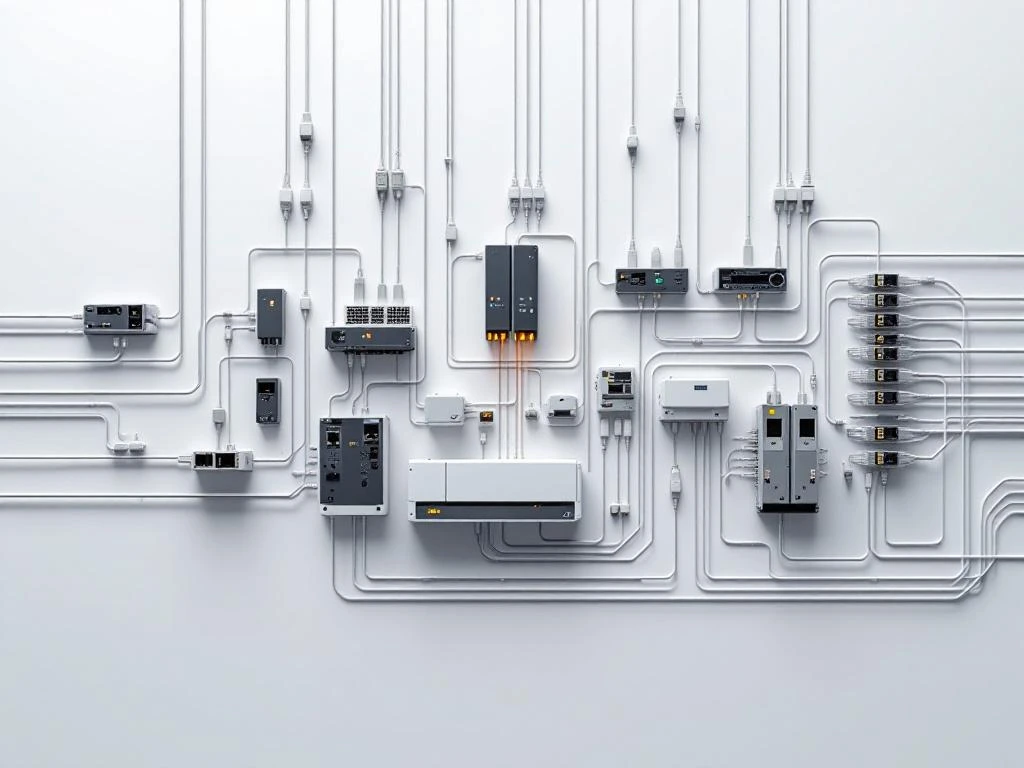
PLCs communicate with other automation devices through standardized industrial communication protocols that enable data exchange, control commands, and system coordination. These protocols include Ethernet-based networks, fieldbus systems, and serial communications that connect PLCs to sensors, actuators, HMIs, and other control devices. Understanding these communication methods is essential for designing reliable automation networks.
What are the main communication protocols PLCs use to connect with other devices?
PLCs use several primary communication protocols, including EtherNet/IP, Modbus TCP/RTU, PROFIBUS, DeviceNet, and AS-Interface. Each protocol serves specific applications based on speed requirements, device complexity, and network architecture needs in industrial automation environments.
EtherNet/IP has become the dominant protocol for modern industrial networks, offering high-speed communication and seamless integration with enterprise systems. It supports both real-time control data and standard IT communications over the same network infrastructure. Modbus TCP provides reliable communication for SCADA systems and is widely supported across devices from different manufacturers.
PROFIBUS remains popular in process automation applications, particularly where deterministic communication timing is critical. DeviceNet excels at connecting simple devices such as sensors and actuators, while AS-Interface provides cost-effective solutions for basic binary devices. The choice depends on your specific application requirements, existing infrastructure, and future expansion plans.
How do PLCs establish communication with HMIs and SCADA systems?
PLCs communicate with HMIs and SCADA systems through dedicated communication drivers and protocols that enable real-time data exchange. The PLC acts as a data server, continuously updating process variables that HMI and SCADA systems read for monitoring and operator interface functions.
The communication process involves the PLC maintaining a data table containing all process variables, alarm states, and system status information. HMI systems establish client connections to poll this data at regular intervals, typically every 100–1000 milliseconds depending on application requirements. When operators issue commands through the HMI interface, these are transmitted back to the PLC as write requests to specific memory addresses.
Modern systems often use OPC (OLE for Process Control) standards to standardize this communication, allowing devices from different manufacturers to communicate seamlessly. The PLC handles prioritization of communication requests, ensuring critical control functions maintain priority over HMI data updates. This architecture enables operators to monitor processes in real time while maintaining system responsiveness for control operations.
What’s the difference between fieldbus and Ethernet communication in PLC networks?
Fieldbus protocols use dedicated industrial communication standards designed for harsh environments, while Ethernet communication leverages standard IT networking technology adapted for industrial applications. Fieldbus typically offers more deterministic timing but lower data speeds compared to Ethernet solutions.
Fieldbus systems such as PROFIBUS and DeviceNet were specifically developed for industrial automation, providing robust communication in electrically noisy environments with precise timing control. These protocols can handle device power and communication over the same cable, simplifying installation and reducing costs for simple devices. However, data rates are typically limited to 12 Mbps or less.
Ethernet-based communication offers significantly higher speeds, often 100 Mbps to 1 Gbps, enabling integration of video, voice, and data on the same network. Modern industrial Ethernet protocols maintain the deterministic timing required for control applications while providing the flexibility to connect with enterprise systems. The trade-off involves higher complexity and cost, but greater capability for data-intensive applications and future expansion.
How do you troubleshoot PLC communication problems with connected devices?
Systematic troubleshooting starts with verifying physical connections, then checking protocol configuration, and finally testing data flow between devices. Use diagnostic tools to isolate whether problems exist at the hardware, protocol, or application level.
Begin by checking all physical connections, including cables, terminations, and power supplies to connected devices. Verify that communication parameters match between all devices, including baud rates, addresses, and protocol settings. Most PLCs provide diagnostic information showing communication status and error counts for each connected device.
Use network diagnostic tools to monitor actual data traffic and identify communication failures. Check for address conflicts, timing issues, or electromagnetic interference affecting signal quality. Many modern systems include built-in diagnostics that highlight specific communication faults, making troubleshooting more straightforward. Document your findings and solutions to build a knowledge base for future troubleshooting efforts.
Protocol analyzers can capture and decode communication messages, helping identify exactly where communication breaks down. This systematic approach helps resolve issues quickly while building understanding of your network’s normal operating patterns.
What factors should you consider when designing a PLC communication network?
Network design requires careful consideration of topology, protocol selection, bandwidth requirements, redundancy planning, and security measures. These factors determine system reliability, performance, and ability to meet future expansion needs in industrial automation applications.
Network topology affects both performance and fault tolerance. Star topologies provide excellent fault isolation but require more infrastructure, while bus topologies reduce cabling but create single points of failure. Consider the physical layout of your facility and the criticality of different network segments when selecting a topology.
Protocol selection should align with device requirements, speed needs, and integration capabilities. Evaluate whether you need deterministic timing for critical control functions or can prioritize flexibility and data capacity. Plan for bandwidth requirements, including normal operation, peak loads, and future expansion, to prevent network congestion.
Redundancy planning ensures continued operation during component failures. This might include duplicate communication paths, backup controllers, or automatic failover systems, depending on process criticality. Security measures protect against both accidental configuration changes and intentional cyber threats through network segmentation, access controls, and monitoring systems.
Understanding PLC communication enables you to design robust automation networks that meet both current operational needs and future expansion requirements. We specialize in comprehensive process automation solutions that optimize communication networks for maximum efficiency and reliability. Proper planning and implementation of these communication principles ensure your automation systems deliver consistent performance while providing the flexibility needed for evolving industrial requirements.