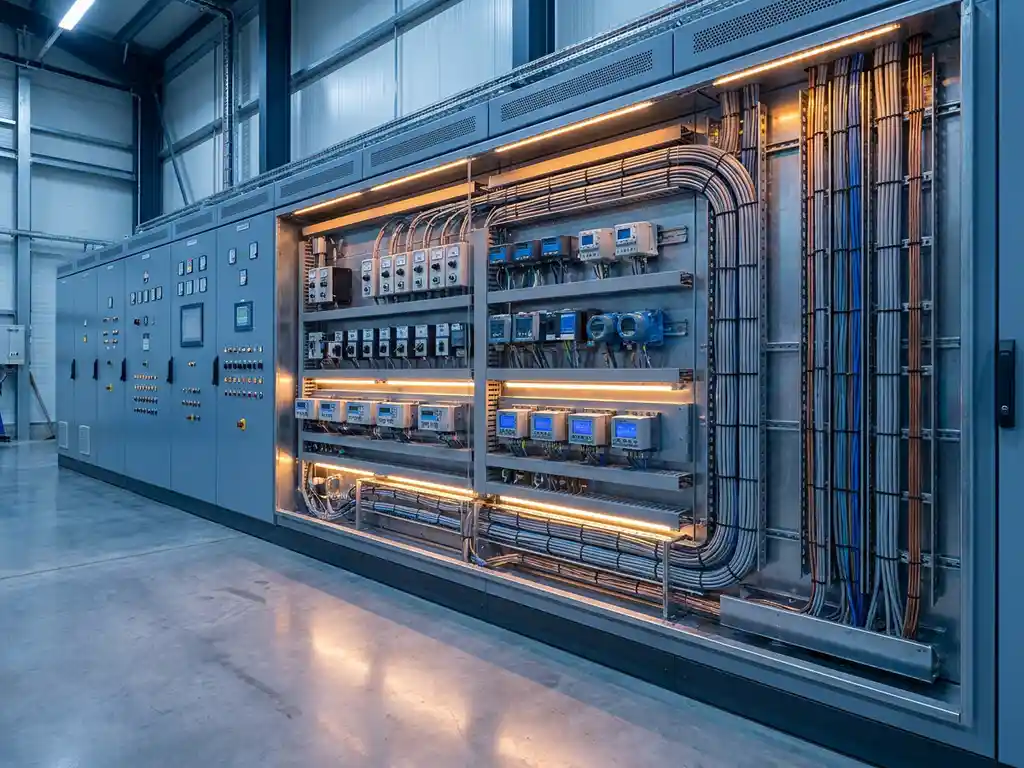

A Distributed Control System (DCS) is primarily used in continuous and batch process industries where large-scale, complex operations need to be monitored and controlled in real time. Oil and gas, chemical processing, power generation, food and beverage, and water treatment are the most common sectors that rely on DCS technology. The sections below explore the most frequently asked questions about DCS applications, capabilities, and evolution.
Which industries rely most heavily on DCS?
The industries that rely most heavily on DCS are those running continuous or large-scale batch processes where precise, coordinated control of many variables is critical. These include oil and gas, chemical and petrochemical production, power generation, food and beverage manufacturing, pharmaceuticals, pulp and paper, and water and wastewater treatment.
In these sectors, processes run around the clock and involve hundreds or even thousands of control loops operating simultaneously. A DCS is built specifically to handle this kind of complexity. In an oil refinery, for example, temperature, pressure, flow, and composition must all be managed together across multiple process units. A single uncontrolled variable can affect product quality, energy efficiency, or safety. The DCS ties all of these loops together under a centralised supervisory layer while distributing the actual control logic across field-level controllers, which keeps the system resilient even if one part fails.
Pharmaceutical and food manufacturing add another layer of requirements: regulatory compliance. In these industries, every process step must be documented, traceable, and reproducible. DCS platforms are well suited to this because they provide integrated data logging, alarm management, and batch record functionality that supports compliance with standards like FDA 21 CFR Part 11 or EHEDG guidelines.
How does a DCS manage complex process control?
A DCS manages complex process control by distributing control functions across multiple controllers that communicate over a high-speed process network, all coordinated through a central operator interface. Rather than relying on a single central processor, the system spreads the control load, which improves reliability and allows each controller to handle its assigned loops independently.
At the field level, sensors and actuators feed real-time data into distributed controllers. These controllers execute control algorithms, such as PID loops, cascade control, or feedforward strategies, locally and continuously. The results are passed up to the supervisory layer, where operators can monitor process values, adjust setpoints, and respond to alarms from a unified interface.
What makes a DCS particularly powerful for complex processes is the tight integration between these layers. Because all controllers share a common database and communicate over a deterministic network, the system can coordinate control actions across process units in ways that a collection of standalone controllers cannot. Advanced process control strategies, including model predictive control, can be layered on top of the basic DCS architecture to further optimise performance and energy use.
What’s the difference between DCS and SCADA in industrial applications?
The key difference between DCS and SCADA is scope and architecture. A DCS is a tightly integrated control system designed for continuous process control within a single plant or facility, with controllers distributed close to the process. SCADA (Supervisory Control and Data Acquisition) is designed to monitor and control assets spread across wide geographic areas, such as pipelines or electrical grids, where communication latency is more acceptable.
DCS: built for process continuity
A DCS keeps control logic local to the process. If communications between a field controller and the central server are interrupted, the controller continues to operate autonomously. This makes DCS highly suitable for processes where a control interruption would cause immediate safety or quality problems. The system is engineered for tight feedback loops, fast scan times, and deep integration between process units.
SCADA: built for distributed visibility
SCADA systems prioritise data collection and remote supervision over distributed assets. The control logic often resides in PLCs at each remote site, and the SCADA software provides a centralised view and the ability to issue commands. Because assets can be hundreds of kilometres apart, some communication delay is accepted. SCADA is the right choice for utilities, transmission networks, and infrastructure management.
In practice, the boundary between DCS and SCADA has blurred as both technologies have adopted modern networking, open standards, and similar human-machine interface designs. Some large installations use elements of both architectures in a layered approach.
When should a plant choose DCS over PLC-based automation?
A plant should choose DCS over PLC-based automation when the process is continuous, involves many interdependent control loops, and requires integrated operator management, alarm handling, and data historian functions out of the box. DCS is the stronger choice when process complexity, reliability requirements, and the need for a unified engineering environment outweigh the lower upfront cost of a PLC architecture.
PLCs are excellent for discrete, sequential, or machine-level control tasks. They are fast, cost-effective, and straightforward to program for well-defined logic. However, when a plant has dozens of process units that must operate together, each requiring its own control loops, interlocks, and operator displays, building that system from individual PLCs and separate SCADA software quickly becomes complicated to engineer, maintain, and expand.
A DCS provides a unified engineering environment where process graphics, control logic, alarm management, and historical data are all managed from a single platform. This reduces integration effort, simplifies training, and makes it easier to implement changes safely. For processes in chemicals, oil and gas, or power generation where uptime is critical and process interactions are constant, the investment in a DCS typically delivers better long-term outcomes.
What role does DCS play in process safety?
A DCS plays a central role in process safety by providing continuous monitoring of process variables, integrated alarm management, and the ability to initiate controlled shutdowns or protective actions when process conditions move outside safe limits. In many plants, the DCS forms the first layer of protection in the overall safety instrumented system architecture.
Modern DCS platforms can be configured with safety-rated controllers that meet IEC 61511 requirements for Safety Instrumented Systems (SIS). This allows plants to implement Safety Instrumented Functions directly within the DCS environment, reducing the need for entirely separate safety systems in some applications while still maintaining the required independence and integrity levels.
Alarm management is another critical safety contribution. A well-configured DCS helps operators prioritise and respond to abnormal situations before they escalate. This means defining alarm setpoints carefully, suppressing nuisance alarms during startup or shutdown, and presenting operators with clear, actionable information during upset conditions. Poor alarm management is a documented contributing factor in major process incidents, which makes the DCS configuration as important as the hardware itself.
How is DCS evolving with digitalisation and Industry 4.0?
DCS is evolving by integrating with cloud platforms, digital twins, advanced analytics, and open communication standards that connect the control layer to broader enterprise and data systems. Industry 4.0 is pushing DCS from a purely operational tool into a data source that feeds predictive maintenance, process optimisation, and business intelligence applications.
One of the most significant shifts is the adoption of open standards such as OPC UA, which allows DCS platforms to share process data securely with other systems without proprietary middleware. This makes it practical to connect a DCS to a manufacturing execution system, an enterprise resource planning platform, or a cloud-based analytics service without large integration projects.
Digital twins are another growing application. By creating a virtual model of a process that mirrors the real plant, engineers can test control strategies, simulate upset scenarios, and train operators in a risk-free environment. The DCS provides the real-time data that keeps the digital twin synchronised with the actual process.
Cybersecurity has become equally important as DCS systems become more connected. Historically, process control networks were air-gapped from corporate IT systems. As integration increases, DCS vendors and end users must implement network segmentation, access controls, and patch management strategies to protect operational technology from the same threats that face IT systems.
How CoNet helps with DCS implementation and optimisation
We are a Siemens specialist with deep expertise in DCS engineering, process automation, and process safety. Whether you are implementing a new DCS, migrating from a legacy system, or looking to optimise an existing installation, we bring the technical depth and hands-on experience to get it right. Our team works across industries including chemicals, oil and gas, food and beverage, and energy, delivering solutions built on Siemens SIMATIC PCS 7 and related technologies.
Here is what we offer in the context of DCS projects:
- DCS engineering and configuration: From functional design specifications to loop commissioning, we handle the full engineering lifecycle of your DCS project.
- Process safety integration: As the only organisation in the Netherlands certified as both a Siemens PCS 7 Process Safety Specialist and a Siemens COMOS Partner, we integrate safety instrumented functions with the confidence that comes from genuine certification.
- System migration and upgrades: We help plants move from aging control systems to modern DCS platforms with minimal disruption to production.
- Digitalisation and Industry 4.0 integration: We connect your DCS to digital twin environments, cloud analytics, and enterprise systems using open standards and Siemens Digital Industries tools.
- Ongoing maintenance and support: Our DCS engineering and support services provide long-term support, ensuring your DCS continues to perform reliably as your process evolves.
If you are planning a DCS project or want to explore how your current system can be improved, get in touch with us to discuss your specific situation. We are happy to help you find the right approach.
Frequently Asked Questions
How long does a typical DCS implementation project take?
The timeline for a DCS implementation depends heavily on the scale and complexity of the process, but most greenfield projects range from 12 to 24 months from functional design specification to full commissioning. Migrations from legacy systems can take longer if extensive re-engineering of control logic or instrument rewiring is involved. Breaking the project into clearly defined phases — design, factory acceptance testing, site installation, and commissioning — helps keep timelines manageable and reduces the risk of costly delays during startup.
What are the most common mistakes plants make when specifying a DCS?
One of the most frequent mistakes is underestimating the number of I/O points and control loops needed, which leads to costly system expansions shortly after commissioning. Another common error is focusing too heavily on upfront hardware costs while overlooking the long-term implications of vendor lock-in, licensing fees, and the availability of local engineering support. Plants also sometimes neglect to define alarm philosophy and operator display standards early in the project, which results in poorly configured HMIs that are difficult to use during abnormal situations.
Can an existing PLC-based system be migrated to a DCS without shutting down production?
Yes, migration is possible with minimal production disruption, but it requires careful planning and a phased approach. Typically, the new DCS infrastructure is installed and configured in parallel with the existing system, with cutover carried out loop-by-loop or unit-by-unit during planned maintenance windows. A thorough Factory Acceptance Test (FAT) of the new system before site installation is critical to reducing the risk of unexpected issues during live cutover. Working with an experienced DCS integrator who has done similar migrations significantly improves the chances of a smooth transition.
How do you ensure cybersecurity when connecting a DCS to cloud or enterprise systems?
The foundation of DCS cybersecurity is network segmentation — keeping the process control network isolated from corporate IT and external networks using demilitarised zones (DMZ) and industrial firewalls. Data exchange with cloud or enterprise systems should be handled through secure, one-directional data diodes or properly configured OPC UA connections with authentication and encryption enabled. Beyond architecture, plants must also establish access control policies, maintain a regular patch management schedule for DCS software, and conduct periodic security audits aligned with standards such as IEC 62443.
What is a Factory Acceptance Test (FAT) and why is it critical for DCS projects?
A Factory Acceptance Test is a structured testing phase carried out at the system integrator’s or vendor’s facility before the DCS is shipped to site. During the FAT, the complete control system — including all configured logic, operator displays, alarm lists, and communication interfaces — is tested against the functional design specification using simulated process inputs. Identifying and resolving issues at this stage is far less costly and disruptive than discovering them during site commissioning. A well-executed FAT also gives the operations team an early opportunity to familiarise themselves with the new system before it goes live.
How often should a DCS be upgraded or replaced, and what are the warning signs that it's time?
Most DCS platforms have a supported lifecycle of 15 to 20 years, but the decision to upgrade or replace should be driven by practical indicators rather than age alone. Key warning signs include difficulty sourcing spare parts, the vendor withdrawing support for the platform, increasing frequency of unexplained faults, and an inability to integrate with modern communication standards or analytics tools. A formal obsolescence assessment, carried out periodically with your DCS vendor or integrator, helps plants plan migrations proactively rather than being forced into emergency replacements.
What operator training is required after a new DCS is commissioned?
Effective operator training should cover both the functional operation of the new HMI and the underlying process control philosophy, not just button-by-button navigation. Simulation-based training, using a digital twin or an operator training simulator connected to the DCS, is the most effective approach because it allows operators to practise responding to abnormal situations in a risk-free environment. Training should be completed before go-live and refreshed periodically, particularly after significant system changes or when new operators join the team. Investing in thorough training directly reduces the likelihood of operator error contributing to process incidents.