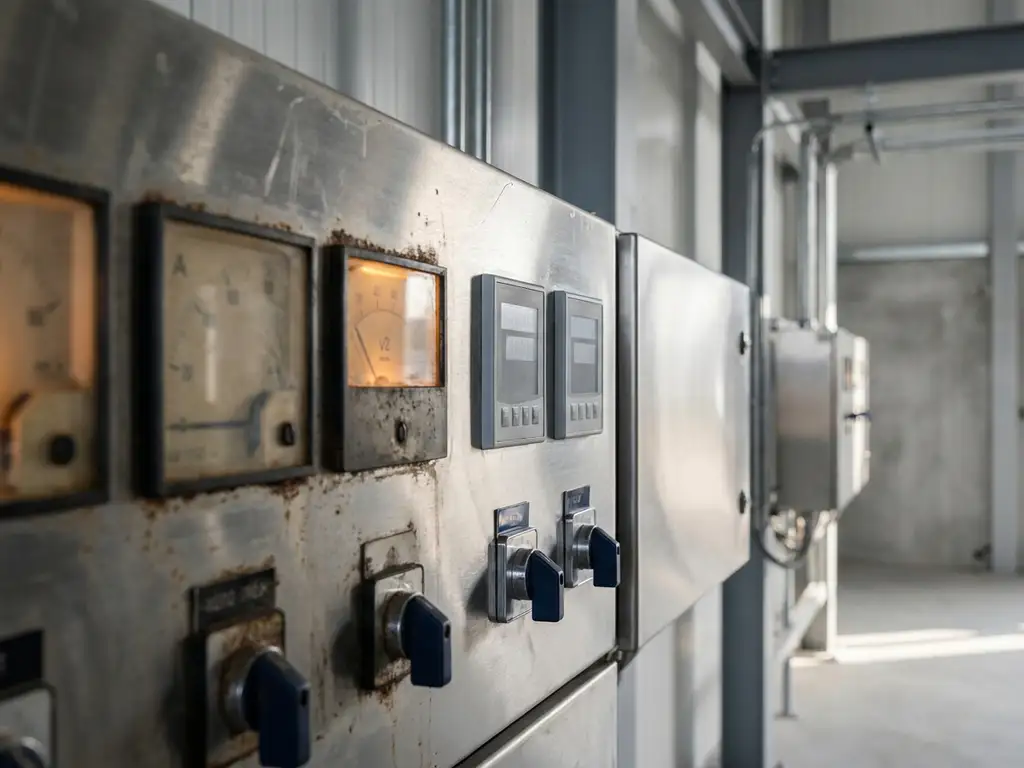

A PLC (Programmable Logic Controller) is an industrial computer that controls manufacturing processes and equipment by reading inputs from sensors and switches, then sending outputs to motors, valves, and other devices. It acts as the brain of automated systems, making real-time decisions based on programmed instructions to keep production running smoothly, safely, and efficiently.
What exactly is a PLC and how does it control industrial processes?
A Programmable Logic Controller is a ruggedised industrial computer designed to withstand harsh factory environments while controlling automated processes. Unlike regular computers, PLCs are built to operate reliably in extreme temperatures, vibration, electrical noise, and dusty conditions that would damage standard computing equipment.
The PLC functions as the central decision-making unit for industrial operations. It continuously monitors input signals from sensors, switches, and measuring devices throughout your facility. Based on pre-programmed logic, it then sends control signals to output devices such as motors, pumps, valves, and conveyor belts to maintain optimal process conditions.
Modern PLCs contain several key components: a processor that executes your control program, memory modules that store instructions and data, input/output modules that interface with field devices, and communication ports for networking with other systems. This modular design allows you to customise the PLC configuration to match your specific process requirements, whether you are managing a simple packaging line or complex chemical processing operations.
How does a PLC actually communicate with machines and equipment?
PLCs communicate with industrial equipment through input/output (I/O) systems that convert real-world signals into digital information the processor can understand. Input modules receive signals from sensors measuring temperature, pressure, flow rates, and position, while output modules send control signals to actuators, motors, and valves.
The communication process uses various signal types. Digital inputs detect simple on/off conditions, such as whether a safety door is closed or a part is present. Analogue inputs measure continuous values such as temperature readings or pressure levels. Similarly, digital outputs control devices that are either on or off, while analogue outputs provide variable control signals for precise positioning or speed control.
Communication protocols enable PLCs to share information with other automation systems. Industrial protocols such as Profibus, EtherNet/IP, and Modbus allow your PLC to communicate with human-machine interfaces (HMIs), supervisory systems, and other PLCs across your facility. This networking capability means your PLC can coordinate with broader factory systems, sharing production data and receiving instructions from higher-level management systems.
What’s the difference between a PLC and other automation systems?
PLCs differ from other automation systems primarily in their flexibility and application focus. Unlike hardwired relay panels that require physical rewiring for changes, PLCs use software programming that you can modify quickly to adapt to new production requirements or process improvements.
Compared with Distributed Control Systems (DCS), PLCs are typically more cost-effective for discrete manufacturing processes such as assembly lines, packaging, and material handling. DCSs excel in continuous process industries such as oil refining or chemical production, where complex process control algorithms and extensive operator interfaces are essential. PLCs handle sequential operations and discrete control tasks more efficiently.
SCADA (Supervisory Control and Data Acquisition) systems work alongside PLCs rather than replacing them. SCADA provides the human interface and data collection capabilities, while PLCs perform the actual process control. Think of PLCs as the hands-on controllers making immediate decisions, while SCADA systems offer the oversight and historical data analysis that plant managers need for optimisation.
Basic control systems such as simple timers or standalone controllers lack the programmability and communication capabilities that make PLCs valuable. PLCs integrate multiple control functions into one system, reducing complexity and improving reliability compared with using numerous individual controllers.
Why do modern factories rely on PLCs for process optimisation?
Modern factories depend on PLCs because they deliver consistent performance and operational flexibility that directly impact productivity and profitability. PLCs eliminate human error in repetitive tasks, ensuring that processes run exactly as programmed every time, which reduces product defects and waste.
The real-time response capabilities of PLCs enable immediate adjustments to changing conditions. When a sensor detects a deviation from optimal parameters, the PLC responds within milliseconds to correct the situation, preventing quality issues or equipment damage that could halt production. This rapid response capability minimises downtime and maintains consistent product quality.
PLCs enhance workplace safety by monitoring critical safety systems and implementing emergency shutdown procedures faster than human operators could react. They continuously check safety interlocks, monitor hazardous conditions, and execute predetermined safety sequences to protect both personnel and equipment.
The diagnostic capabilities built into modern PLCs provide valuable insights for maintenance planning and process optimisation. They track equipment performance, identify potential problems before failures occur, and collect operational data that helps you understand how to improve efficiency. We work with manufacturing facilities to implement these advanced process automation solutions, helping transform production processes into highly efficient, reliable operations that adapt to changing market demands while maintaining the precision and quality standards that competitive manufacturing requires.