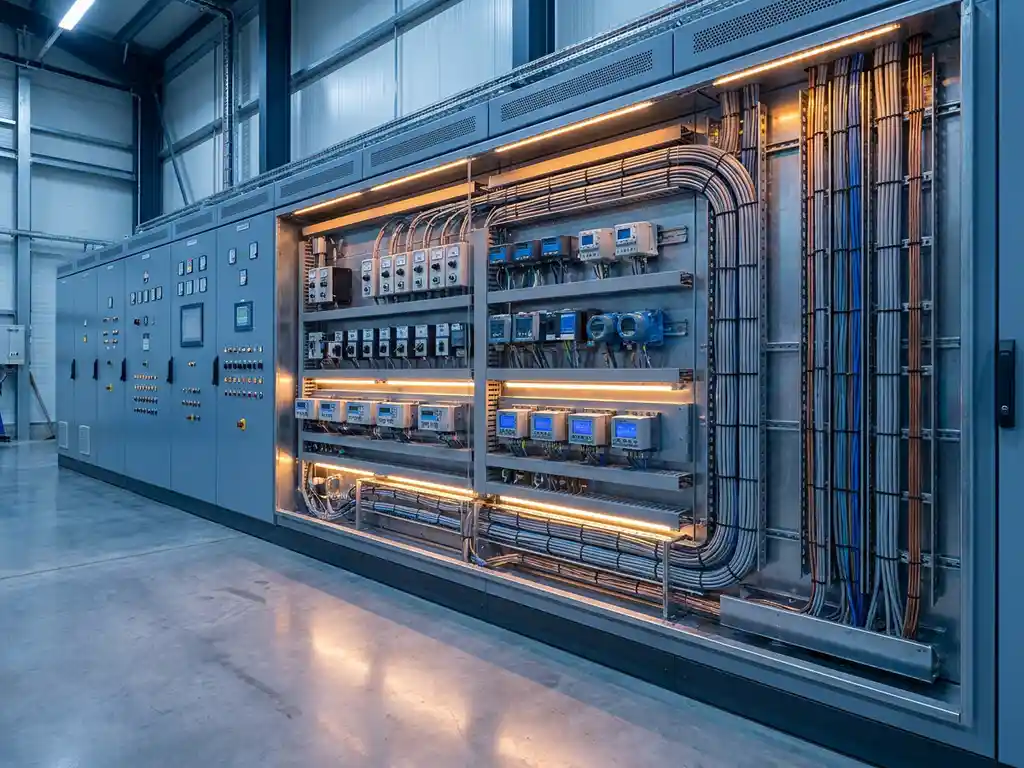

A compact PLC is a self-contained unit where the processor, I/O, and power supply are built into a single housing, while a modular PLC separates these components into individual modules that slot into a shared rack or backplane. The key difference comes down to flexibility: compact PLCs are fixed in their configuration, whereas modular PLCs can be customized and scaled to match the exact demands of an application. The sections below walk through each question in detail so you can make a confident choice for your next project.
How does a compact PLC differ from a modular PLC in hardware design?
A compact PLC integrates all core functions — CPU, power supply, and input/output channels — into one enclosed unit. A modular PLC distributes those same functions across separate, interchangeable modules that are mounted onto a rack or rail system. This fundamental hardware difference shapes how each type is installed, expanded, and maintained throughout its working life.
In a compact design, the manufacturer fixes the number and type of I/O points at the factory. You get a defined set of digital and sometimes analog channels, and that configuration does not change. This makes the hardware straightforward to install and commission, but it also means you accept the built-in constraints.
In a modular design, the rack acts as a backbone. You choose a CPU module, add the exact I/O modules you need, and fill remaining slots as your application grows. Each module communicates with the others through the backplane, and the system behaves as a single coherent controller despite being assembled from separate parts. This architecture gives engineers precise control over the hardware footprint from day one.
What are the advantages of a compact PLC?
The main advantages of a compact PLC are its lower cost, smaller physical footprint, and faster time to commissioning. Because everything is pre-integrated, there is less wiring, fewer components to source, and a simpler installation process. For straightforward automation tasks with a predictable I/O count, a compact PLC is often the most practical and cost-effective choice.
- Lower upfront cost: A single integrated unit is generally less expensive than a rack, CPU module, and multiple I/O modules combined.
- Compact size: The small housing fits easily into tight control cabinets or machines where space is at a premium.
- Faster setup: Fewer components mean less wiring time and a shorter path from unboxing to first scan.
- Simpler maintenance: With everything in one unit, fault diagnosis is more straightforward for smaller systems.
- Sufficient for many applications: Conveyor control, pump stations, and small packaging machines rarely need more than what a compact PLC provides out of the box.
What are the advantages of a modular PLC?
The primary advantages of a modular PLC are scalability, flexibility, and the ability to tailor the hardware precisely to the application. Because each function lives in its own module, you can add capacity, swap out components, or upgrade individual parts without replacing the entire controller. This makes modular PLCs the preferred choice for complex, large-scale, or long-running industrial automation projects.
- Scalability: Add I/O modules, communication modules, or specialty function modules as the process grows.
- Precise configuration: Select only the signal types and channel counts you actually need, avoiding wasted capacity.
- Easier fault isolation: A faulty module can be replaced individually without taking the entire controller offline for extended periods.
- Higher I/O capacity: Modular systems can handle hundreds or even thousands of I/O points within a single system architecture.
- Redundancy options: Many modular platforms support redundant CPU and power supply configurations, which is critical in process industries where uptime is non-negotiable.
- Longer lifecycle adaptability: As processes change over years or decades, the hardware can evolve with them rather than requiring a full replacement.
When should you choose a compact PLC over a modular one?
Choose a compact PLC when your application has a fixed, well-defined I/O requirement that is unlikely to change, and when cost and cabinet space are important constraints. If the machine or process you are automating is self-contained, operates independently, and does not need to grow in complexity, a compact programmable logic controller will serve you well without the overhead of a modular system.
Practical scenarios where a compact PLC is the right call include standalone machines such as small mixers or dosing units, building automation subsystems, simple conveyor lines, and OEM equipment where the design is repeated across many identical units. In these cases, the fixed configuration is a feature rather than a limitation because it keeps the bill of materials predictable and the design replicable.
A modular PLC becomes the better choice when I/O counts are high, when the process is likely to expand, when redundancy is required, or when the application spans multiple areas of a plant and needs centralized control with distributed I/O. In short, the more complex and long-lived the system, the stronger the case for going modular.
Can a compact PLC be expanded with additional modules?
Some compact PLCs can be expanded with a limited number of additional I/O modules, but this expansion capability is always more restricted than what a fully modular system offers. The compact controller retains its fixed core, and the expansion options are defined by the manufacturer. Once you reach the expansion ceiling, the only path forward is to replace the controller or add a second system.
Siemens, for example, offers expansion modules for several compact controller families that allow additional digital or analog channels to be connected. However, the total I/O count remains far below what a modular rack-based system can achieve. If you anticipate significant growth, it is worth planning for a modular architecture from the start rather than reaching the limits of a compact system mid-project and facing a costly migration.
Which Siemens PLCs are compact and which are modular?
Siemens offers both compact and modular PLC families across its SIMATIC product range. The SIMATIC S7-1200 is Siemens’ primary compact controller, designed for small to medium automation tasks with a fixed CPU housing and optional signal board and module expansion. The SIMATIC S7-1500 is Siemens’ flagship modular controller, built on a rack-based architecture that supports extensive I/O expansion, redundancy, and advanced process control.
The SIMATIC S7-300 was the long-established modular workhorse of Siemens automation for decades, though it has been succeeded by the S7-1500 in new projects. The ET 200SP and ET 200MP are distributed I/O systems that work alongside both compact and modular CPUs, extending reach across large plants without running long cable runs back to a central cabinet.
For process automation specifically, Siemens PCS 7 is built around modular hardware because the scale and reliability demands of continuous process industries require the flexibility and redundancy that only a modular architecture can provide. Choosing the right Siemens PLC family depends on matching the hardware capabilities to the process requirements, the expected system lifetime, and the engineering resources available for ongoing support.
How CoNet helps you choose and implement the right PLC architecture
Selecting between a compact and modular PLC is not just a hardware decision. It affects your engineering hours, your maintenance strategy, and your ability to adapt the system over the years ahead. As a Siemens specialist with decades of hands-on experience across the chemical, food and beverage, oil and gas, and energy sectors, we help our clients make that choice with confidence and then deliver it properly.
When you work with us, you benefit from:
- Independent technical advice: We assess your process requirements and recommend the right Siemens PLC family for your specific application, whether that is an S7-1200 for a standalone unit or a full S7-1500 modular system for a complex plant.
- End-to-end engineering: From specification and design through programming, testing, and commissioning, our team handles the full project lifecycle.
- PCS 7 expertise: As the only company in the Netherlands certified as a PCS 7 Process Safety Specialist, we bring a level of process automation depth that goes beyond standard PLC integration. You can learn more about what we offer through our plant automation services.
- Long-term support: We do not disappear after commissioning. Our team is available for ongoing maintenance, upgrades, and optimization as your process evolves.
- One point of contact: As both a Certified Solution Partner for SIMATIC PCS 7 and a Siemens Digital Grid partner, we cover process automation and energy management under one roof.
If you are evaluating a new automation project or reviewing an existing system and want a straightforward conversation about whether a compact or modular PLC is the right fit, get in touch with us and we will be happy to think it through with you.