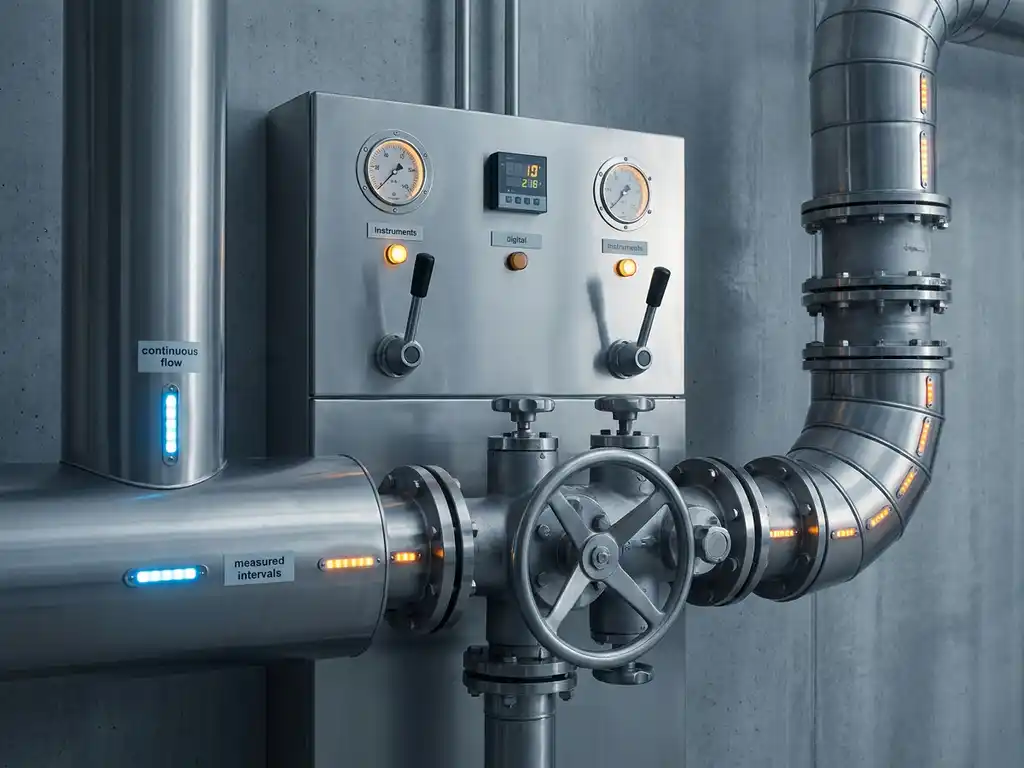

Open-loop control and closed-loop control are two fundamentally different approaches to PLC automation. In open-loop control, a PLC sends a command and assumes it has been carried out, with no verification. In closed-loop control, the system continuously monitors the actual output using sensors and adjusts its commands based on real-world feedback. Understanding the difference is essential for choosing the right control strategy for your process.
How does open-loop PLC control actually work?
In open-loop PLC control, the controller sends a fixed output signal based on a predefined instruction, without checking whether the desired result was actually achieved. The system operates in one direction only: input goes in, output comes out, and no measurement is taken to verify the outcome. This makes open-loop control simple, fast, and predictable in stable environments.
A practical example is a conveyor belt that runs at a set speed for a fixed duration. The PLC sends the “run for 30 seconds” command and moves on. It does not check whether the belt actually moved, whether a jam occurred, or whether the load affected the speed. The instruction is executed once, and the system assumes the result is correct.
Open-loop systems work well when the process is consistent and disturbances are minimal. They are commonly used in timing-based operations, simple actuator control, and processes where the output is highly predictable. The trade-off is that any deviation from expected conditions goes undetected and uncorrected.
How does closed-loop PLC control use feedback?
Closed-loop PLC control uses sensor feedback to continuously compare the actual process output against a desired setpoint, and adjusts the control signal in real time to eliminate any difference. This feedback loop allows the system to self-correct, compensating for disturbances, load changes, or environmental variation without manual intervention.
The core mechanism works in three steps: the PLC issues a control signal, a sensor measures the actual result, and the PLC calculates the error between the setpoint and the measured value. It then adjusts the output to reduce that error. This cycle repeats continuously throughout operation.
The most common implementation of feedback control in industrial PLC systems is the PID controller, which stands for Proportional, Integral, and Derivative. Each component handles a different aspect of the correction:
- Proportional: Responds to the current size of the error
- Integral: Addresses accumulated error over time to eliminate steady-state offset
- Derivative: Anticipates future error based on the rate of change
Together, these three elements allow a closed-loop PLC system to maintain precise, stable control even as conditions change around it.
What are the main differences between open-loop and closed-loop control?
The main difference between open-loop and closed-loop PLC control is feedback. Open-loop systems execute commands without measuring outcomes, while closed-loop systems continuously monitor results and adjust accordingly. This single distinction drives nearly every practical difference in performance, complexity, and application suitability.
Here is a direct comparison of the two approaches:
- Feedback: Open-loop has none; closed-loop relies on it entirely
- Self-correction: Open-loop cannot compensate for disturbances; closed-loop corrects automatically
- Complexity: Open-loop is simpler to design and commission; closed-loop requires tuning and sensor integration
- Accuracy: Open-loop is sufficient for predictable processes; closed-loop is necessary where precision matters
- Cost: Open-loop is lower cost upfront; closed-loop requires additional sensors and programming effort
- Stability risk: Open-loop is inherently stable; closed-loop can become unstable if poorly tuned
Neither approach is universally better. The right choice depends on the nature of the process, the acceptable margin of error, and the variability of operating conditions.
When should you use open-loop instead of closed-loop control?
Open-loop control is the better choice when the process output is highly predictable, disturbances are negligible, and the cost of adding feedback would outweigh its benefits. It is appropriate for simple, repeatable tasks where the relationship between input and output is well understood and consistent.
Common scenarios where open-loop PLC control is a practical and effective choice include:
- Fixed-time operations such as timers, delays, and sequenced steps
- On/off control of actuators where position feedback is not required
- Processes with stable loads and predictable environmental conditions
- High-speed switching applications where feedback would introduce latency
- Low-stakes auxiliary functions where minor deviations are acceptable
When conditions are variable, when precision is critical, or when the process involves dynamic loads, closed-loop control becomes necessary. The decision often comes down to whether the cost of an error, in quality, safety, or waste, justifies the added investment in feedback infrastructure.
What happens when closed-loop PLC control is poorly tuned?
When closed-loop PLC control is poorly tuned, the system either overreacts or underreacts to deviations from the setpoint, causing instability, oscillation, or persistent steady-state error. Poor tuning is one of the most common sources of performance problems in industrial feedback control systems and can lead to product quality issues, equipment wear, and in serious cases, unsafe operating conditions.
The specific symptoms depend on which PID parameters are misconfigured:
- Too much proportional gain: The system overshoots the setpoint and oscillates around it without settling
- Too little proportional gain: The system responds sluggishly and may never fully reach the setpoint
- Excessive integral action: The system accumulates correction too aggressively, causing windup and overshoot
- Too much derivative action: The controller amplifies noise in the sensor signal, causing erratic output
In process industries such as chemical manufacturing or food production, a poorly tuned loop can mean the difference between a stable batch and a rejected one. Regular loop performance reviews and systematic retuning, especially after process changes, are essential maintenance practices for any closed-loop control system.
Which Siemens PLC systems support closed-loop control?
Several Siemens PLC platforms support closed-loop control, with the most capable options found in the SIMATIC S7 family and the SIMATIC PCS 7 process control system. These platforms include integrated PID function blocks, advanced loop management tools, and support for both standard regulatory control and more complex control strategies.
Key Siemens systems with strong closed-loop control capabilities include:
- SIMATIC S7-1500: Supports PID control through TIA Portal with PID Compact and PID Professional function blocks, suitable for machine and factory automation
- SIMATIC S7-300/400: Established platforms with extensive PID library support, widely deployed in process industries
- SIMATIC PCS 7: Siemens’ dedicated process control system, designed specifically for complex closed-loop control in continuous processes such as chemical, oil and gas, and food production
- SIMATIC ET 200SP: Distributed I/O with local PID capability, useful for decentralized control architectures
SIMATIC PCS 7 in particular offers advanced features such as loop monitoring, automatic tuning assistance, and integration with safety instrumented systems, making it the preferred platform for demanding process automation environments where plant automation requires both precision and reliability.
How CoNet helps with open-loop and closed-loop PLC control
We are CoNet, a Siemens specialist with deep expertise in process automation and control system engineering. Whether you are evaluating whether open-loop or closed-loop control is right for your application, or you need to improve the performance of an existing feedback loop, we bring the technical knowledge and hands-on experience to get it right. As the only company in the Netherlands certified as a PCS 7 Process Safety Specialist and Siemens COMOS partner, we work exclusively with Siemens technology, which means our advice is always specific, grounded, and directly applicable.
Here is what we offer when it comes to PLC control strategy and implementation:
- Control strategy assessment to determine whether open-loop or closed-loop is appropriate for your process
- PID loop design, commissioning, and tuning for SIMATIC S7 and PCS 7 platforms
- Loop performance analysis and retuning for underperforming or unstable control loops
- Engineering support for complex multi-loop and cascade control configurations
- Integration of closed-loop control with process safety and energy management systems
If you want to improve the accuracy, stability, or efficiency of your control systems, we are ready to help. Contact us to discuss your application and find out how we can support your automation goals.