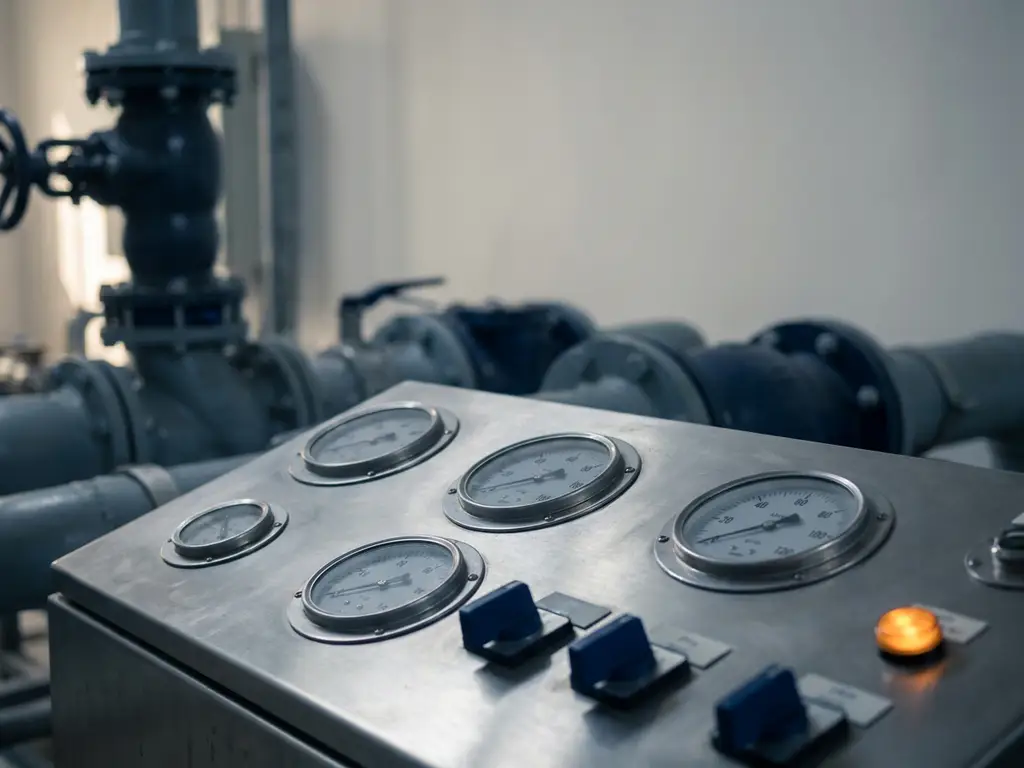

Poor PLC grounding directly undermines system reliability by allowing electrical noise, voltage fluctuations, and fault currents to interfere with sensitive control circuits. When grounding is inadequate, PLCs become vulnerable to erratic behavior, unexpected shutdowns, corrupted data, and hardware damage. These problems affect any industrial facility running automated processes, from food production lines to chemical plants. The sections below unpack each dimension of this issue, from root causes to best practices.
How does poor PLC grounding cause electrical noise and interference?
Poor PLC grounding creates unintended voltage differences between system components, which generate electrical noise that rides along signal and power lines. When a PLC lacks a clean, low-impedance path to earth, stray currents from motors, variable frequency drives, and switching power supplies have nowhere controlled to go. They couple into I/O wiring and communication cables instead, injecting noise directly into the control system.
The most common mechanism is a ground loop. This occurs when two pieces of equipment are grounded at different points in a facility, each with a slightly different earth potential. Current flows between those points through the signal cables connecting the devices, creating a continuous low-frequency noise signal. In environments with heavy motor loads, this noise can be severe enough to cause analog sensors to report false values or digital inputs to trigger without any real process change.
High-frequency noise from variable frequency drives is particularly damaging. VFDs switch at high frequencies and generate significant common-mode noise. Without proper grounding and shielding, this noise couples into PLC input cards and can saturate analog channels or corrupt encoder feedback signals. The result is a control system that appears to malfunction for no obvious reason.
What failures can bad grounding cause in a PLC system?
Bad grounding in a PLC system can cause a wide range of failures, from nuisance faults and intermittent errors to permanent hardware damage. The severity depends on how poor the grounding is and what electrical environment surrounds the system. Even minor grounding deficiencies can produce symptoms that are difficult to trace back to their root cause.
Common failures associated with grounding faults in PLC systems include:
- Unexpected program faults and CPU resets caused by noise-induced memory corruption or watchdog timer trips
- False input signals where digital inputs register as active when the connected field device has not changed state
- Analog signal drift where sensors report inaccurate values due to noise on the signal reference
- I/O card damage from transient overvoltages that a proper ground would have safely dissipated
- Communication timeouts and bus errors on fieldbus and industrial Ethernet networks
- Intermittent process shutdowns triggered by safety systems responding to corrupted sensor data
In worst-case scenarios, a grounding fault can allow dangerous fault currents to flow through signal cables rather than through the protective earth conductor. This not only risks equipment damage but can also create safety hazards for personnel working near the affected equipment.
Why is poor PLC grounding so difficult to diagnose?
Poor PLC grounding is difficult to diagnose because its symptoms are intermittent, varied, and often mimic other types of faults. A technician investigating a spurious CPU fault or a drifting analog input will typically look first at the program logic, the sensor, or the power supply. Grounding problems rarely appear on a fault log as “grounding issue” and instead show up as unexplained resets, inconsistent readings, or communication errors that come and go.
Several factors make the diagnosis even harder:
- Load dependency: Grounding problems often only manifest when large motors or drives are running, meaning the system behaves normally during low-load testing and only fails during production
- Temperature sensitivity: Ground connections can become resistive as they corrode or loosen, and their resistance changes with temperature, making faults appear and disappear with ambient conditions
- Cumulative degradation: A system that worked reliably for years can develop grounding issues gradually as connections oxidize or cable insulation degrades, making it hard to identify a clear trigger event
- Measurement challenges: Measuring ground impedance requires specialist equipment and technique. A standard multimeter reading of near-zero ohms does not confirm a good ground under dynamic conditions
The intermittent nature of PLC grounding problems means they are frequently misattributed to software bugs, aging hardware, or supplier component quality. This leads to time-consuming and ultimately unsuccessful troubleshooting until someone performs a systematic grounding audit.
How does grounding quality affect PLC communication networks?
Grounding quality has a direct and significant impact on PLC communication network performance. Industrial protocols such as PROFIBUS, PROFINET, Modbus, and EtherNet/IP all rely on stable voltage references and clean signal paths. When grounding is poor, common-mode noise raises the noise floor on these networks, increasing the bit error rate and causing retransmissions, timeouts, and in severe cases, complete loss of communication with remote I/O or field devices.
PROFIBUS is particularly sensitive to grounding quality. The RS-485 physical layer used by PROFIBUS depends on a consistent cable shield reference. If the shield is not grounded correctly at one end, or if there are multiple grounding points creating ground loops, the differential signal becomes corrupted. Network diagnostics will show increasing error counters and eventually devices dropping off the bus entirely.
Industrial Ethernet networks are more tolerant but not immune. Ethernet uses differential signaling and transformer coupling, which provides some inherent noise rejection. However, severe grounding faults can still introduce enough common-mode noise to cause packet errors and link instability. In time-sensitive applications using PROFINET IRT or similar deterministic protocols, even occasional packet loss can cause process control deviations.
Proper cable shielding works hand in hand with grounding. A shielded cable with a poorly grounded shield offers little protection and can actually act as an antenna, collecting noise and injecting it into the system. The shield must be terminated to a clean earth reference to function as intended.
What are the best practices for proper PLC grounding?
Proper PLC grounding requires a systematic approach that establishes a single, low-impedance path to earth for all control system components, eliminates ground loops, and keeps power and signal grounds separated where necessary. Following established best practices significantly reduces the risk of electrical noise, equipment damage, and unreliable operation.
Key best practices for industrial automation grounding include:
- Use a dedicated instrument earth: Separate the instrument earth from the power earth to prevent noise from motor and drive circuits from coupling into the control system
- Star grounding topology: Connect all ground points back to a single central reference point rather than daisy-chaining them, which prevents ground loops
- Low-impedance connections: Use short, large cross-section conductors for ground connections and ensure all terminations are clean, tight, and corrosion-free
- Correct shield termination: Terminate cable shields at one end only (typically the control panel end) to avoid creating a ground loop through the shield
- Separate cable routing: Route power cables and signal cables in separate cable trays with physical separation to reduce capacitive and inductive coupling
- Ground the PLC chassis and rack: Ensure the PLC chassis is bonded to the control panel earth bar with a dedicated, short conductor
- Follow manufacturer specifications: Siemens SIMATIC PLC documentation provides specific grounding requirements for each product family. These should be followed precisely during installation
For facilities running plant automation across multiple buildings or large production areas, earth potential differences between buildings are a common source of grounding problems. Isolating field devices or using galvanic isolators on signal lines can resolve these issues where a common earth reference is impractical.
When should a PLC grounding system be inspected or retested?
A PLC grounding system should be inspected at least annually and retested whenever significant changes are made to the electrical installation or process equipment. Beyond routine maintenance intervals, specific events and conditions should trigger an immediate grounding review.
Situations that warrant a grounding inspection include:
- Installation of new motors, drives, or large electrical loads near the control system
- Any unexplained increase in PLC faults, communication errors, or process disturbances
- After a lightning strike or significant power event at the facility
- Following any modification to the control panel or field wiring
- When equipment is relocated or new cable routes are installed
- After extended periods of high humidity or flooding that may have affected ground connections
During an inspection, all ground connections should be checked for tightness, corrosion, and continuity. Ground impedance should be measured with appropriate test equipment under realistic load conditions, not just with a static resistance measurement. Cable shield continuity and termination points should also be verified.
In older facilities, grounding infrastructure installed decades ago may no longer meet the demands of modern automation equipment. A comprehensive grounding audit is a worthwhile investment before any major control system upgrade, as existing deficiencies will be amplified when newer, more sensitive hardware is introduced.
How CoNet helps with PLC grounding and system reliability
At CoNet, we combine deep Siemens expertise with practical field experience across the chemical, food and beverage, oil and gas, and energy sectors to help our clients resolve grounding problems and build reliable automation systems from the ground up. As the leading Siemens PCS 7 specialist in the Netherlands, we understand exactly how grounding deficiencies interact with SIMATIC hardware, PROFIBUS networks, and PROFINET architectures.
When clients come to us with unexplained PLC faults or communication instability, our engineers approach the problem systematically. Here is what we bring to grounding-related challenges:
- Structured grounding audits that go beyond a basic continuity check and assess the full electrical environment
- Hands-on troubleshooting of intermittent faults, including noise analysis on fieldbus and Ethernet networks
- Engineering of new installations with correct grounding architecture from the design phase
- Advice on cable routing, shield termination, and separation of power and instrument earths
- Integration of grounding best practices into broader plant automation projects, ensuring reliability across the entire control system
Whether you are dealing with an existing reliability problem or planning a new installation, we are ready to help. Contact us to discuss your situation and find out how we can support your automation goals.