
A programmable logic controller, or PLC, is a ruggedized industrial computer designed to monitor inputs from sensors and machines, execute a stored control program, and trigger outputs to control equipment in real time. PLCs were developed to replace hard-wired relay panels in manufacturing environments, making control logic easier to modify without rewiring physical hardware. The sections below unpack how PLC components, programming, and connectivity work together in modern industrial automation.
What are the main components inside a PLC?
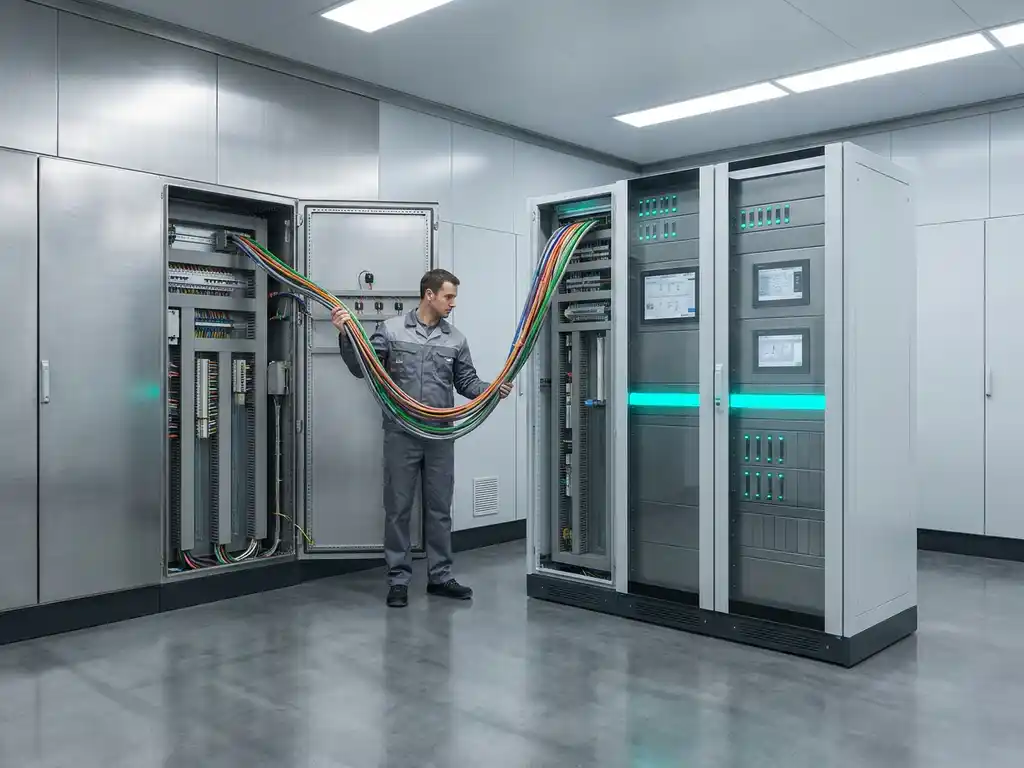
A PLC consists of four core hardware components: a central processing unit (CPU), input and output modules, a power supply, and a programming interface. The CPU executes the control program, the I/O modules connect to field devices, the power supply keeps everything running, and the programming interface allows engineers to load and modify logic.
Each component plays a specific role in the overall system:
- CPU: The brain of the PLC. It reads input data, runs the control program, and updates output states in a continuous cycle.
- Input modules: Receive signals from field devices such as sensors, switches, and flow meters. These can be digital (on/off) or analog (variable values like temperature or pressure).
- Output modules: Send signals to actuators, motors, valves, and other devices based on the CPU’s decisions. Like inputs, these can be digital or analog.
- Power supply: Converts mains voltage to the low-voltage DC power the PLC’s internal components require.
- Programming device or interface: A laptop, handheld terminal, or engineering workstation used to write, upload, and monitor the control program.
Modern PLCs often include additional components such as communication modules for connecting to industrial networks, memory cards for program backup, and specialty modules for motion control or safety functions. Modular PLC designs allow engineers to expand the system by adding extra I/O racks as a process grows.
How does a PLC process inputs and control outputs?
A PLC works by continuously executing a scan cycle that consists of three repeating steps: reading all input states into memory, executing the control program logic against those stored values, and then writing the resulting output states to the output modules. This cycle typically completes in milliseconds, giving the impression of simultaneous, real-time control.
The scan cycle ensures that the CPU always works from a consistent snapshot of the process rather than reacting to inputs mid-program, which prevents unpredictable behavior. At the end of each scan, the output modules physically switch devices on or off, or adjust analog signals, based on what the program calculated. If an input changes during a scan, that change is captured at the start of the next cycle.
This deterministic behavior is one of the reasons PLCs are trusted in safety-critical environments. Engineers can predict exactly when and how the controller will respond to any given input condition, which is essential for process reliability and safety certification.
What programming languages are used to program a PLC?
PLCs are programmed using one or more of the five languages defined by the IEC 61131-3 standard: Ladder Diagram (LD), Function Block Diagram (FBD), Structured Text (ST), Instruction List (IL), and Sequential Function Chart (SFC). Ladder Diagram is by far the most widely used, particularly among engineers with a relay logic background.
Graphical languages
Ladder Diagram represents logic as rungs on a ladder, mimicking relay circuit drawings. This makes it intuitive for electricians and control engineers who learned on relay panels. Function Block Diagram uses graphical blocks connected by signal lines, which suits process engineers who think in terms of signal flow and functional units.
Text-based and structured languages
Structured Text resembles high-level programming languages like Pascal and is well suited to complex mathematical calculations, loops, and data manipulation. Sequential Function Chart breaks a process into steps and transitions, making it ideal for batch processes or machine sequences with clearly defined stages. Instruction List, the lowest-level option, is similar to assembly language and is less commonly used in new projects as of 2026.
What is the difference between a PLC and a DCS?
The key difference between a PLC and a Distributed Control System (DCS) is scope and architecture. A PLC is a standalone or networked controller optimized for discrete, high-speed machine control. A DCS is a plant-wide system with distributed controllers, integrated operator stations, and a unified database designed for continuous process control across large, complex facilities.
In practical terms, PLCs excel at fast, event-driven tasks such as packaging lines, conveyors, and safety interlocks. DCS platforms are better suited to continuous processes like chemical reactions, distillation columns, or power generation, where thousands of analog loops must be coordinated through a single integrated environment. Siemens SIMATIC PCS 7, for example, is a DCS that integrates PLC-level controllers with a plant-wide engineering and operations framework.
The boundary between PLCs and DCS platforms has blurred significantly in recent years. Modern PLCs handle analog control loops that once required a DCS, while DCS platforms now incorporate high-speed discrete control. The choice increasingly depends on the scale of the installation, the required integration depth, and the long-term operational model of the facility rather than a strict technical divide.
Where are PLCs commonly used in industry?
PLCs are used across virtually every sector of industry wherever automated machine or process control is needed. They are most common in manufacturing, food and beverage production, chemical processing, oil and gas, water treatment, and energy generation. Anywhere a process needs to be started, stopped, sequenced, or monitored automatically, a PLC is likely involved.
Specific applications include:
- Conveyor and material handling systems in warehouses and production lines
- Filling, capping, and labeling machines in food and beverage plants
- Pump and valve control in water and wastewater treatment facilities
- Burner management and safety shutdown systems in oil and gas installations
- Motor control centers and switchgear in energy infrastructure
- Batch control and reactor management in chemical and pharmaceutical plants
The rugged construction of PLCs makes them well suited to industrial environments where temperature swings, vibration, dust, and electrical interference would damage conventional computing hardware. Their deterministic scan cycle also makes them reliable for safety-critical applications where response time must be guaranteed.
How do modern PLCs connect to SCADA and industrial networks?
Modern PLCs connect to SCADA systems and industrial networks through standardized communication protocols and dedicated network modules. Common protocols include PROFINET, PROFIBUS, Modbus TCP, EtherNet/IP, and OPC UA. These connections allow PLCs to share real-time data with supervisory systems, historian databases, and other controllers across a plant.
A SCADA (Supervisory Control and Data Acquisition) system sits above the PLC layer, collecting data from multiple controllers and presenting it to operators through graphical displays. The PLC continues to execute its local control program independently; SCADA adds visibility, alarming, and reporting on top of that local control. This layered architecture means a network interruption does not stop the PLC from controlling the process.
As industrial networks converge with IT infrastructure, PLCs increasingly support secure remote access, cloud connectivity, and integration with manufacturing execution systems (MES). OPC UA has become a key enabler of this integration because it provides a standardized, vendor-neutral way to expose PLC data to higher-level systems. Cybersecurity has become a corresponding priority, with network segmentation, firewalls, and encrypted communications now standard practice in new plant automation designs.
How CoNet helps with PLC and industrial automation
We at CoNet bring over 25 years of hands-on experience helping industrial companies get the most out of their automation infrastructure. As the leading Siemens PCS 7 specialist in the Netherlands and one of the top PCS 7 Partners worldwide, we support the full lifecycle of PLC and process automation projects, from initial engineering and programming through commissioning, optimization, and ongoing maintenance.
When you work with us, you benefit from:
- Deep Siemens expertise: We are the only company in the Netherlands certified as both a PCS 7 Process Safety Specialist and a Siemens COMOS partner, giving you access to specialist knowledge that is difficult to find elsewhere.
- Single point of contact: We cover process automation, plant automation, and digital grid solutions under one roof, so you never have to coordinate between multiple vendors.
- Sector experience: We work across chemical, oil and gas, food and beverage, and energy industries, so our engineers understand the specific demands of your environment.
- Engineering capacity: With around 40,000 to 50,000 hours of engineering delivered annually, we have the scale to support both small upgrades and large greenfield projects.
Whether you are evaluating a new PLC architecture, migrating from an older system, or looking to connect your controllers to modern SCADA and network infrastructure, we are ready to help. Get in touch with our team to discuss your automation challenge and find out how we can support your project.